Given that our house is in the more populous south of Sweden and barely 60 miles from the country’s second city, we still live fairly remotely.
However, it’s important to maintain a sense of perspective. As Ingemar, the young hero of ‘My Life as a Dog’ points out, ‘man måste jämfora’ – ‘you’ve got to compare’. I could be Laika, the Russian dog, floating around in outer space, apparently. Or an inhabitant of the far north of Swedish Lapland where you’re more likely to meet reindeer than human beings.
Still, we’re three kilometres down a dirt track from the nearest village (pop. 200), can see no other houses from our own, and have about a kilometre to our nearest year-round neighbour.
Not that I’m complaining. This is probably the closest I’m going to get to Nirvana before my body composts back into the cosmic vortex.
But it does present logistical problems.
Even in the age of satellite navigation, the tree cover here is so thick that delivery vans often get lost. And on the odd occasion that we use a taxi driver, we have to pay in advance since card readers don’t work within a radius of about two km of our house. Needless to say, you can also forget about using a mobile phone unless the sky is cloudless and the wind favourable. Even then you have to climb up onto the roof.
When you consider that we also have our own water supply and our own sewerage system, and that both are dependent on electricity, then you’ll realise that this Nirvana requires the patience of a Buddha.
As for visitors and delivery men, even if they’re not relying on GPS and know where they’re going, getting here is not always as simple as it sounds. Not that we’re a special case or anything. There are almost four times as many enskilda or private roads in Sweden as there are those that are the responsibility of the government or local council. And most of these private ones are dirt roads.
Which does raise the interesting question of who is responsible for them. The answer in our case is the village vägförening. Which in turn raises the interesting question of how to translate that term into English. In this case, I’d suggest ‘road committee’. ‘Corporation’ is far too grand for a group of property owners, numbering little more than a dozen, and most of whom are owners of the woodland that surrounds us. ‘Club’ makes it sound like you’re trifling with our only means of connection with the outside world, while ‘Society’ makes it all sound far too sociable.
In principle, anyone that owns property and thus needs access to that property has a right to be represented on this committee and a duty to pay towards the upkeep of the same. If that duty sounds too painful, the pain is alleviated considerably by the State grants that are available and that generally cover the most usual maintenance costs.
I’ll be saying a lot more about the concept of the förening in a future blog, since I find the subject more fascinating than you probably do. It’s a perk of the job. For now, however, there is little more that needs to be said on the subject. But I won’t let that stop me. Since the notion of responsibility is a great deal more complicated than you would ever imagine.
OK. So are you ready for this? I suggest you take notes as you go along.
The Committee (the least I can do is give it a capital letter) answers for the general upkeep of the road. Since the road consists of dirt, this means re-dirting it every spring after the Big Thaw. Or to be more precise, since the road is usually frozen to an antipodal depth, after the Big Thaw and the Big Sogginess that automatically follows. The Big Sog (if you’ll forgive the abbreviation) in turn causes cars to sink to their axles in mud and leave ruts that from Outer Space probably look like landing grounds for alien craft. So before any re-dirting can be done, the surface has to be levelled off or ‘planed’. After all that, there isn’t usually much road left, so the term, re-surfacing, is probably understating the case.
Along with that, the Committee also has to provide for proper drainage. This entails maintaining the ditches at the side of the road and the culverts at intervals below it, without which the road would disappear even more often than it does in the normal course of events.
I’m not entirely sure who is responsible for trimming the verges. Again probably a misnomer in this case, since the verges in question are in most cases an extension of the forest. So any attempt to keep the road clear of obstructions involves trimming those overhanging branches and trunks that have not fallen without human intervention during the latest storm.
According to the overriding national authority that sets the parameters for the upkeep of all infrastructure in the country, all road maintenance should take into consideration environmental and ‘aesthetic’ demands. Which presumably would be news to the barbarian that went down our road a couple of years ago with something resembling a combine harvester rather than a hedge trimmer and reduced the so-called verges to debris to a depth of about a metre, thus ripping out all of the willow that lined the entrance to our drive.
Thankfully most of the time the trimming is less enthusiastic than this.
Up to now, I’m sure you’ll agree, things look pretty uncomplicated.
‘But what happens when it snows?’ I hear you asking.
Good question. Well done, that girl at the back!
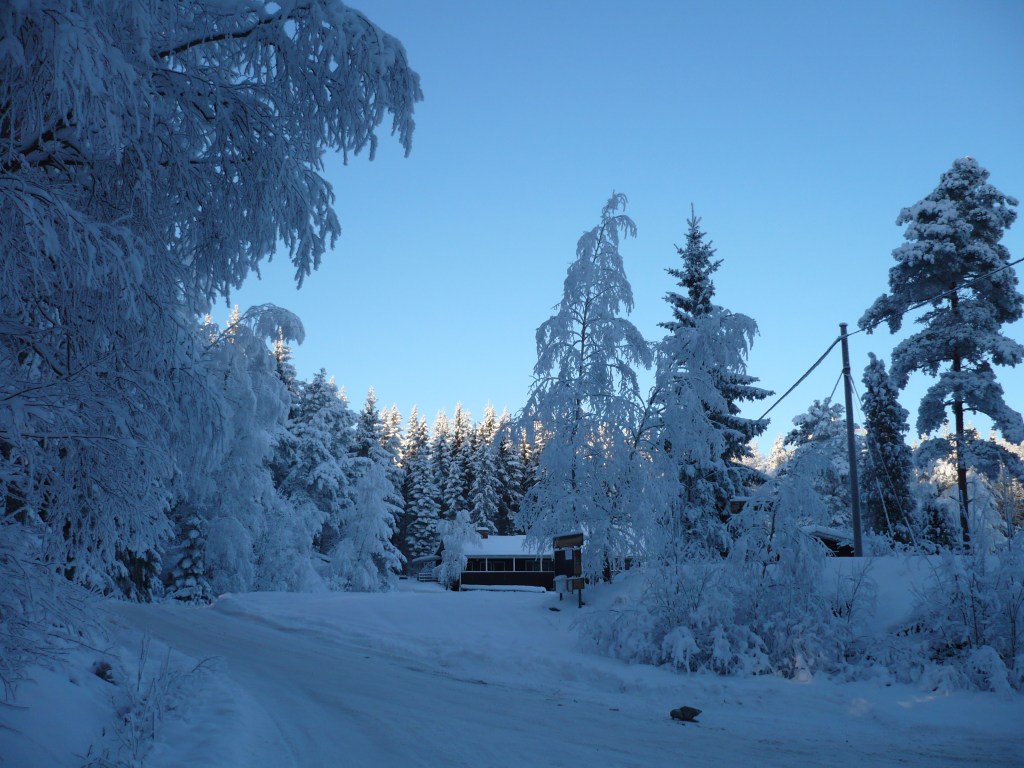
Hitherto, it’s the local council that has held the brief for clearing snow on all roads within the area. With certain provisos. For example, I’m sure that girl at the back is dying to ask how much snow has to lie on the ground before ploughing has to begin. The answer is technically 8cm of loose snow. Not at all unreasonable if, like any good citizen, you are equipped with snow tyres. The problem has been that news can take time to reach the metropolis from the backwoods. And, understandably, more major roads have priority. So it’s not been unusual for us to be snowed in for a couple of days before we can get out. The problem has also been compounded by the fact that the council has apparently been in the habit of contracting out the work to the cheapest tender and thus the doziest entrepreneur.
The more observant amongst you will have observed my use of tenses. For last year the council decided to devolve that responsibility to, you’ve guessed, our brave Committee. So now, in addition to the 1 Crown (about 12p) per metre subsidy the council grants us for general maintenance, we will be awarded a further 2 Crowns to cover the cost of snow clearance. This is not in itself a bad thing, of course. Our Committee is local and therefore much more aware of local conditions than the town council is. They’re also much more efficient, though how far an extra few pence will stretch is another question.
If I have a complaint (and what else am I here for, after all?) it concerns the timing of this handover. It would have made perfect sense to have the transfer of responsibility occur when there was no snow on the ground, thus allowing time for the local road committees to get their respective acts together. Instead, the switch coincided, it’d seem, with what the Council interpreted as the ‘end’ of the winter season this year.
Now, officially this year spring ended on 20th March. So presumably on 20th March our Committee took over. Under normal circumstances that would be the end of the story. But this year we were hit by a freak snow storm, followed by very high winds on 2nd of April. Within the space of 8 hours about half a metre of snow fell. What’s more, the high winds meant that it wasn’t only the white stuff that blocked our way out to so-called civilisation and the salary my wife brings in. The road was also littered with fallen trees and boughs.
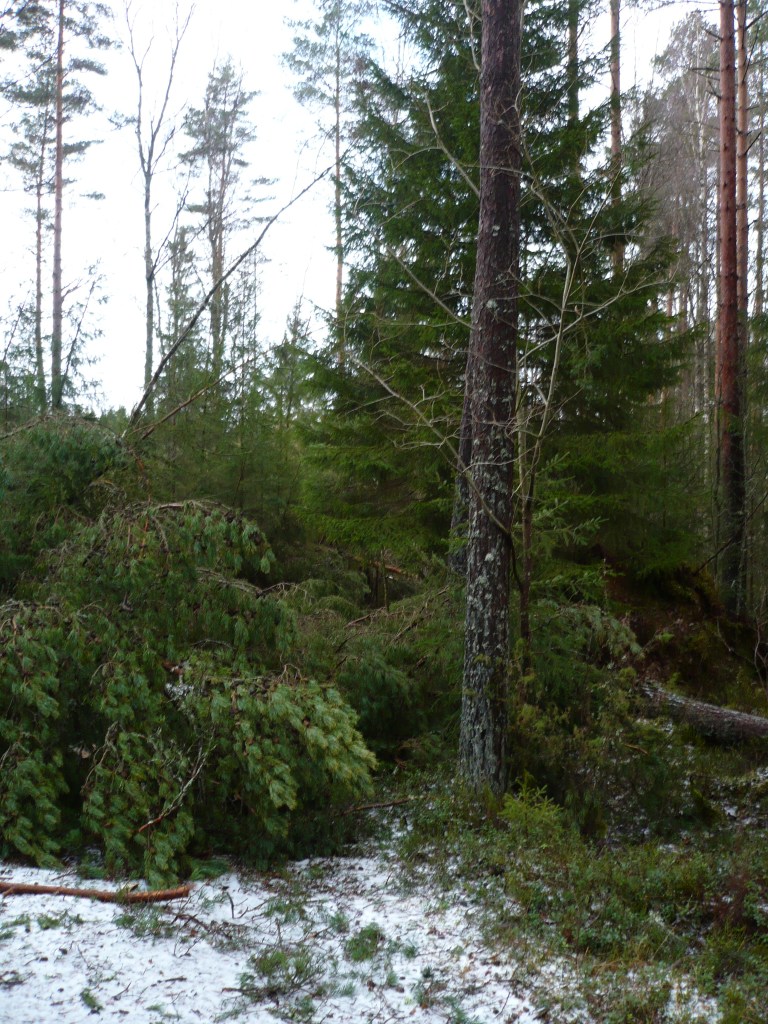
So let’s hear it for the brave villager that ventured out so soon in a tractor with an ill-adapted rear-fit scraper, and ploughed and hacked his lonely furrow all the way to our drive and beyond. It wasn’t pretty, but it allowed us to escape.
And what’s the moral of the story then, gentle reader? Well, Number One:- you can’t trust the weather any more (or, any more than you could ever trust it). Number Two:- whatever the official start of spring may be, if you’re still demanding cars are fitted with winter tyres (conditions demanding) until the middle of April, then it’s plain idiocy to consider anything earlier as any more than a notional end of the snow weather.
So what then do we, as the only year-round 24/7 householders, along this stretch of road actually contribute to said road’s general well-being and peace of mind?
Well, as mentioned, we are expected to cough up our share as and when required, though so far this has not proved to be too much of a burden on our finances.
We also have a right, and thus in the Swedish context, a civic duty to play our part. And since we are not in the possession of road planers, dump trucks or snow ploughs, the only way we can pitch in is by attending the AGM and expressing our support for or constructive criticism of the way the road is being managed.
I have tried this a couple of times. The meetings are announced in the local free-sheet and held in the village Community Centre. (Again the term is a little too grandiose for a ‘community’ of about 200 souls.)
The first time I attended, I was greeted with what, locally, passes for politeness. And that was about all I understood. The owners of the forest along our road are pretty much all local farmers, and like farmers tend to do, they speak in the local dialect – in this case, West Gothic or Västgötska. The fact that this word is itself difficult to pronounce will give you some measure of the difficulty I experience with whole sentences of it. The first time I heard it, I took it for Norwegian.
Just as I was beginning to get the hang of a few words here and there, some completely alien names were flung into the mix. The only one I now remember is flyet. I’ve tried this out in a dictionary and mysteriously enough it comes with the definitions of ‘a plane’ and ‘a nocturnal moth’ (aren’t they all nocturnal?), neither of which are very helpful when talking about a thoroughfare.
As it turned out, ‘flyet’ (and the other extra-terrestrial names) all referred to sections of our road. Absolutely indispensable when you’re talking about what part needs fixing, but absolutely impenetrable to an outsider.
Oh well. Clearly they felt that I deserved some reward for having been subjected to an hour of what to my pathetic ears might just as well have been Outer Mongolian. So after the meeting, I was led downstairs where the wife of the chairman was waiting with coffee and cake. I eyed the cake suspiciously. It looked all too much like one of my childhood hates – egg custard. But no, I was reassured. This was a local delicacy called kalvdans.
What a lovely name! I thought. If it makes the calves dance, then goodness knows what friskiness it will impart to a superannuated Englishman. Made with the cow’s first milk, what’s more, the lady proudly pointed out. Full of antibodies, peptides and other exciting pharmaceuticals. Then I felt the prick of conscience. Who was I to deprive new-born calves of their first vaccination? Miserably, I pictured the poor young things dropping like flies as I stuffed myself. But then again, I supposed, the calves would not be missing their dance in the abattoir. So that was alright then.
I took a bite and my smile turned to a grimace, no matter how hard I tried to disguise it. It tasted just like egg custard – the best emetic I’m aware of.
This wasn’t the last time I took part in the AGM. Sometimes my wife is unable to attend, so I deputise for her. It was, however, the last time I was offered any refreshments afterwards.
I realise I have made our fellow villagers appear like the Transylvanian peasants in Nosferatu. I appear on the scene and they all fall quiet without me even asking for Dracula. They are, of course, nothing of the kind. And neither am I in search of vampires, for that matter. They are the salt of the earth and I am an outsider that doesn’t even speak the language properly. They don’t talk much. But actions speak louder than words. And when we need help, they are ready to give it. Without them we would have difficulty surviving here. Which would be a shame. Because if we didn’t, we would be dead. Or have to leave. Both of which would also be a pity. However much this blog sounds like an extended whine, there is no other place outside the tropics I would prefer to live.
So having got that straight, I hope you will take the continuing adventures of the Babes in the Wood in the right spirit. Because I haven’t even started with the real shit. (Ours, that is.)
 Letters from Sweden