A few years ago I was sitting on the front steps of our house, trying to assemble a flat-pack wheelbarrow. Not very successfully.
My attention kept wandering. To the blooming flowers, to the leafing trees, and to why the summer brought out the best in Sweden. As if the inhabitants also bloomed with the sunshine.
Every now and then, I would reflect, philosophically of course, on why anyone should dispatch a wheel barrow as a flat-pack. I mean, the tray itself is bowl-shaped. Perhaps this was what is called an economy of scale – that it somehow works out cheaper to send the thing in misshaped bits rather than adding a couple of centimetres to the package and a whole kilometre to customer-satisfaction, by sending the barrow ready-assembled.
And every now and then, I would give up the meditation and launch into an engaging blend of English and Swedish swearwords to the entertainment, and edification, of passers-by. You may ask yourself why the mix. Well, the Swedish came more readily, the English added more intensity, for the very good reason that all Swedish curses involve God and/ or the Devil. If you don’t believe in either, the impact is softened to a gentle chiding.
I don’t know why we Swedes choose to swear by something most no longer believe in. As usual, the Danes are way ahead and integrated a good ‘fuck’ or ‘fucking’ years ago. Though if you listened to anyone speaking Danish, you might be left wondering where the ‘fucking’ had gone to. The answer lies in the key to decoding the language. That is, to approach it as you might a half-completed cryptic crossword puzzle. Since the middle of any given word is swallowed in its utterance, you are left to fill in the gap based upon the context and your knowledge of the world.
In the gap between God, the Devil and pagan curses upon Dispatch Managers as a species, I noticed someone coming up the drive. This doesn’t happen often. Our nearest neighbours live a kilometre away. They’re not in the habit of dropping in, any more than the rest of Sweden is, without an appointment made several months in advance. So this wasn’t one of them. Indeed, I didn’t recognise the figure at all. I judged it to be about 12 years old and of indeterminate pre-pubescent gender. As it came closer I noticed that its face was level with mine, even though I was sitting on the steps. Blond hair, blue eyes and dressed in white, it looked like a pint-sized angel – a putto, perhaps. Though without the inflated cheeks, probably down to the fact that it wasn’t blowing a trumpet.
In its hands was an empty 2-litre bottle of Coke. Bit of a cheek, I thought. Does this look like a 7-Eleven? I looked behind me to check. No, it was still clearly a private cottage.
Then it spoke. Definitely male.
‘Terribly sorry to trouble you, but I wonder if you would be ever so kind and allow me to refill this bottle with water.’ Or words to that effect. ‘I couldn’t help noticing that you have a tap outside, but felt it only polite to ask before using it.’
The language was Swedish, but the hyper-polite manner was über- English.
‘Spot of bother with the motor,’ he explained as he held the bottle under the tap.
‘Motor,’ I burbled.
He nodded.
‘Apart from the radiator, she’s in pretty good shape. Given her age, of course.’
My eyebrows reached what was left of my hairline.
‘Care to take a look?’
You bet.
I stuck my head back through the doorway and told my wife I was just going down the road, and why.
‘I’ve got to see this,’ she said.
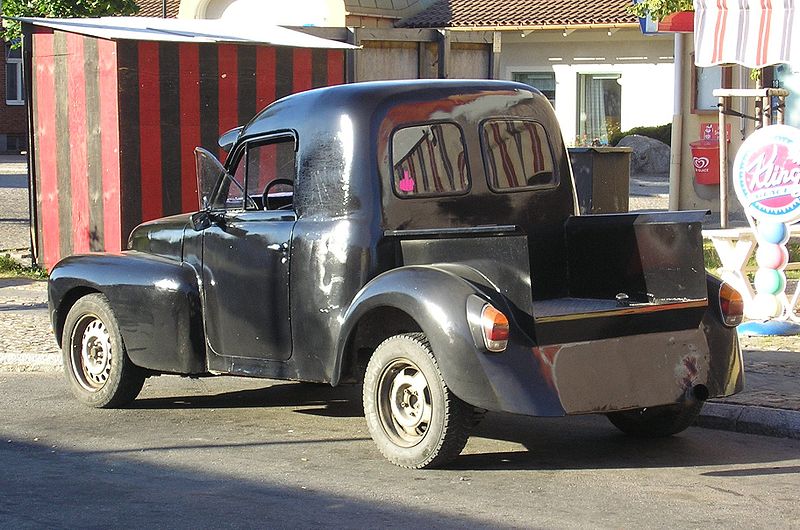
We walked towards the lake. At the side of the road, he’d parked what looked like a black Lincoln. Or at the very least, one of those limousines they use in funeral corteges. Time was when it might even have been a bank robbery get-away car.
As we approached, a small head appeared round the side of the passenger seat, followed by a small hand that waved at us.
‘You’ll have to forgive my younger brother,’ our escort said, flipping up the bonnet. ‘He gets a little bit over-excited on these jaunts.’
When he’d filled the radiator, he turned and shook our hands, my wife’s shake being accompanied with a gallant bow of the head.
‘Can’t thank you enough,’ climbing into the driver’s seat and peering through the steering wheel. ‘If I can ever return the favour….’
Not much chance of that, I thought. I had no idea who he was or where he came from. I liked to think he was on the run and wished him luck.
The car moved off with a wheel spin and a spray of gravel. Then settled to a cruising speed of about 20 mph.
I’d heard of EPA-tractors before and seen them many times, usually parked outside the local high school on graduation day, along with the usual array of decorated flat-bed lorries and tractor trailers.
But I’d never seen one driven by such a diminutive chauffeur.
As far as I know, they are uniquely Swedish.
The phenomenon started in the 1920’s when the custom-built tractor was a rarity in Sweden. So people ended up building their own by converting normal sedans, lorries and buses into tractors. The popular name for these was EPA-tractors, named after a cut-price store. Rather as you might have Aldi bulldozers, and Kwik-Save nuclear reactors, for that matter.
When, in the fifties, normal tractors became cheaper and thus more common, the trend began to die out. Until teenagers seized their chance. EPA tractors were subject to similar laws to genuine tractors and mopeds, meaning amongst other things that since their speed was restricted to that of a moped on Valium, they could be driven before the age required of a normal automobile.
The joy was short-lived. When the government woke up to the fact that youngsters were enjoying themselves, they promptly renamed such vehicles as A-tractors (though they are still familiarly known as EPAs), tightening the safety requirements and mandating a top speed of 30kph. Interestingly, however, the legislation never required seatbelts to be worn or the minimum age to be raised above that required for a moped – that is, fifteen years.
Just a few years ago, moreover, the law was liberalised to allow ordinary cars to be tweaked so they could be classed as A-tractors, resulting in the most recent surge in popularity. After all, a Porsche is still a Porsche even when it’s driven at walking pace and has a triangular warning sign on the back. And what can be tweaked can be un-tweaked. This tweaking is particularly popular in the countryside, especially in the sparse north of Sweden.
The reason I mention all this is that EPAs have recently been much in the news given a spate of (that is, four) fatal accidents involving the vehicles – the victims invariably being the occupants. Reliable sources say that in 2021, 547 people were injured in accidents involving EPAs, a threefold increase over 2016. Even so, it’s worth pointing out that in just the last couple of years the numbers of EPAs on the road has nearly doubled.
Still, I can’t help feeling that the outrage is stoked mainly by other road-users’ frustration at being stuck behind one slow moving vehicle after another. Especially when the EPA driver exercises his/her wit by plastering a sticker on the back that says, ‘Just now, we have many waiting in line. Please be patient and your turn will come.’
Whatever the pretext, Swedish governments need little excuse to legislate, especially when it comes to restricting people’s enjoyment and wilful self-destruction. So it’s no surprise that the response has been to suggest legislation limiting the tendency of the youth of today to act like adrenalin-junkie lemmings. Namely, obligatory seatbelts, a review of the training for an EPA licence and measures that make the tweaking more difficult. And even perhaps a requirement for winter tyres when the roads are icy, as is mandatory for other vehicles.
Which is all a bit of a shame if it discourages the use of such vehicles. The EPA is, as far as I know, a unique tradition in a country that specialises in importing its festivities from other countries. Apart from suicide, that is, in which has been a European leader.
Moreover, these junior locomobiles add a touch of colour and variety in an auto- world that more and more tends towards the monochrome and uniform. Is there anyone out there still who can distinguish between the limited brands of saloon cars? Or anyone that even cares anymore? For it’s not only your standard sedan that can be tweaked. Out on the country roads of Sweden there are vintage cars that have been cut half in half, so to speak, to reduce their seating to the legal limit of two, and the rear to a flat bed.
Probably the most common variant is an adapted Volvo 740. Indeed if you are ever in Sweden and see a Volvo estate with a dog barrier behind the front rather than the back seats, then either the owner has a widely-travelled Shetland pony or the vehicle has been adapted for use by juveniles. A quick check for a rear triangular shield should determine which of the options is most likely.

But the variations on a theme are pretty much limitless. Two-seater sports cars, as I mentioned, are ideal for the purpose and need no surgery. As are artic- cabs (really!), which can come with their own personalised sleeping and cooking spaces. And, yes, you guessed it, even tractors can be customised.
For me personally, it’s not hard to see the attraction of the four-wheel tuned-up moped.
If I’d been offered the chance at the age of 15 to drive something that resembled a car, I would have leapt at it. For a start, it would have enhanced my otherwise minimal chances of attracting girls by mega proportions. It would also have made me feel more like a man than my downy whiskers ever managed. Which is, no doubt, part of the fascination with the institution here too, not least to our miniscule pubescently-challenged visitor.
In fact, even as an adult, I would have seen the benefits. While I can ride a pushbike with something approaching casual aplomb, my career as a motor-powered cyclist was a catalogue of disasters. My first foray, at the age of 22 resulted in me badly spraining my ankle and writing off a newly acquired Honda 50.
I had a longer acquaintance with a post-war moped I bought in Italy to take me from the cottage I was renting into the local station. The duration of its survival was no doubt down to the sturdiness of the beast’s manufacture. For a long time it remained in working order better than I did. I lost count of the number of times I skidded and bounced down the road after my bike in the icy winters of Northern Italy. I also lost count of the resulting bruises.
My arrival at a private lesson rapidly became an event on the social calendar. Vendors would set up stalls and enterprising children would tout tickets. It was even rumoured that someone was taking bets on the exact place and time I would come off the bike and hit the tarmac.
None of this would ever have happened, if I had learnt how to brake a two-wheeler in the accepted fashion. Or if I had been able to buy an EPA.
So, four wheels good, two wheels bad. As it were.
True, you may feel that the absence of a requirement for seat belts verges on the irresponsible and is in urgent need of redressing. But, though to my regret I can’t speak from experience, I can imagine the degree to which inertia-reels interfere with heavy petting while tootling along.
Nonetheless, what’s most remarkable about the exemption is that this is the only domain I can think of where we safety-obsessed Swedes sacrifice security to freedom. And I’m moved to suggest that this sense of automotive security is exaggerated. Not only do belts instil a false sense of indestructibility, but I can also witness to the counterproductive effects when they malfunction.
About a year ago I was negotiating my way down the highways and byways of Costa Rica in a hired car, when suddenly the inertia reel decided to take itself quite literally. I had for a moment leaned back to admire the scenery. When I tried to resume the recommended posture, I found myself suddenly restrained by the seatbelt, which refused to budge from its assumed position. Indeed, I felt myself being ever more constricted by the apparatus, as if I were an innocent rainforest tree being suffocated by a strangler fig. Instead of studying road position and oncoming traffic, I found myself staring at the roof of the car. So I pulled in as soon as there was a space and a lull in traffic and managed to coax the damn thing into a less life-threatening position and survived the rest of the journey by attaching the belt to the steering wheel with one hand while I drove.
Personally then, I’m an admirer of the beltless EPAs and the intrepidity of their drivers.
As for the wheelbarrow, even my wife was defeated, even though she is younger, smarter and altogether a more satisfactory human being than myself.
The upshot was that we now have an assortment of parts, some of which we have assembled into a functional barrow.
We sent a photo of the monster we had constructed to the manufacturers. They concluded that they’d sent the wrong bits. So they sent us the same set again. Finally we figured that the handle to axle unit had to be mounted in a way that defied logic. We felt like idiots. But it gave some satisfaction to know that the manufacturers hadn’t noticed our error. They had obviously never tried assembling one themselves.
So if you need a spare wheel, handlebar or just a leg support for you barrow, just call and collect.
Sources:
wikipedia
wikicommons
Dagens Nyheter
 Letters from Sweden