There’s a lot of a lot of things in Sweden. Urr. Conifers and snow mostly, come to think of it. What are almost totally lacking however, are public conveniences.
True, most cafes, restaurants and pubs, along with large supermarkets have loos. But these are hardly public. You’re supposed to be a customer. And if you’re thinking of sneaking in under false pretences, many of these require a code to be punched in, sometimes revealed only on your receipt. And you might need a shop assistant to open up for you.
So what do you do if you’re caught really short? Well, back to those conifers again (and the snow if you’re of an artistic bent). If you’re out in the countryside there are usually plenty of these to dive behind for a bush pee. Otherwise, you need to rely on the Church of Sweden. Yes, every church I’ve ever checked out has one. And if the church itself is closed, as they usually are out of hours, you’ll find there’s a loo in an outbuilding. You don’t need a code or an assistant to open up for you. What’s more these are to all appearances open 24/7.
It can’t be a coincidence that the Russian word for God is ‘Bog’.
I wonder sometimes how this came about. Is it because the congregations here as elsewhere are largely made up of ageing and potentially incontinent parishioners? It’s a nice idea. But I suspect it goes back farther than that. My theory is that the convenience (joke) originated in the times when sermons were measured in hours rather than minutes. You can still see the hour-glasses in some ancient pulpits.
My digital assistant disagrees and points out that many older churches don’t have the facility. In which case, in recent years they’ve added a shed in the churchyard. Well, OK. But I liked my idea better.
It certainly tallies with one of the angles of this blog – that the Swedish Church, in common with most other churches, has a lot to answer for, given the suffering it has inflicted on the general public over the years – no matter how benignly it may present itself today. But go to it, AI. After all, five-hour sermons with no recourse to bladder relief are even more tortuous.
The Church of Sweden, if you didn’t know it already, is Lutheran. Meaning it is a Reformed Church, and so most definitely not, no siree, Roman Catholic.
Like most, if not all, Protestant national churches, it wasn’t always so.
Christianity was introduced into the country in the 9th century by missionaries and was Catholic – pretty obviously since Luther hadn’t found the door to nail his theses on, mainly because he wasn’t born yet. It gained more traction when a king, who went by the over-complicated name of Olof Skötkonung had himself baptised not far from us in 1008. This was the starting shot for the rest of Sweden to follow. Or else.
By the way, not even AI knows what ‘Skötkonung’ means, so you wonder why he didn’t choose a catchier nick. Like ‘Olof the Sanctimonious’ or something.
There we have it then. Everything was going swimmingly for the Pope until Gustav Vasa, known in English as Gustav Vasa, came along at the beginning of the 16th century. He’s one of the leading candidates for the award of Father of the Country since he liberated Sweden from the yoke of Danish rule and the tyranny of Christian II. Just to underline the point, in Swedish history books, Christian is familiarly known as Christian the Tyrant. The same books claim without foundation that he is known in his home country as Christian the Good. This is simply not true. By the time Danes have managed to articulate his name successfully in their own language, they need to rush off and fortify themselves with a five-layer open sandwich and a pint of Carlsberg. As far as I can make out, the end result of the said articulation is disturbingly similar to ‘Cretin’. No more is needed or possible.
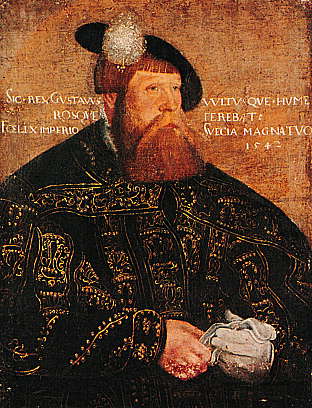
Gustav Vasa
Gustav didn’t manage all this without a struggle. He was top of the Danish ‘Most Wanted’ hit-lists for a long while and was nearly captured while he was holed up in mid-Sweden, living on a diet of stale bread, but managed to escape to Norway on skis. For this reason he is credited with the invention of Swedish crispbread and the annual Vasaloppet ski race.
As if all this wasn’t enough, he also found the time for the Swedish Reformation. This he did in the time-honoured fashion of killing or exiling anyone who disagreed. He also obviously had half an eye on what was happening in Britain. As with Henry VIII, a break with Rome didn’t initially signify a break with Catholicism. It just meant that the King pocketed the proceeds rather than the Pope doing so. So it wasn’t until a decade or two later that the Church realised they needed a more better reason for shattering people’s cherished beliefs than filling the king’s coffers, and adopted Lutheranism.
I wasn’t there at the time and can’t say how your man in the Swedish street felt about all this. Or your man in the Finnish one either, since Finland was owned by Sweden, owing to a series of crusades that persuaded them out of their pagan ways.
One of the most touted benefits of the Reformation in general is its contribution to literacy. As you’ll recall from your school days, the reformed church encouraged personal interaction with God, so the Bible along with church services needed to be conducted in a language the hoi polloi understood. Surely a reason for rejoicing, since this had the ultimate knock-on effect of encouraging August Strindberg. Or perhaps one hand clapping, some to think of it.
There was a significant downside to this, however. In an effort to save the souls of all the ignorant near-pagans and/ or recidivist Catholics in the country, the parish priest was obliged to act as an official moral guardian to the members of his flock. Each year the local pastor would embark on a tour of all the households in his care and subject them to the ‘husförhör’ or home interrogation on the Lutheran catechism, and no doubt whatever else caught the priest’s fancy. Inability to answer questions correctly was subject to a fine. As a result, in many parishes the event was viewed with dread and, where appropriate, the pastor was regarded as an unregenerated bully.
When the practice was finally abolished in the late nineteenth century, the Swedish Church then devoted its energies to pushing for Prohibition. As you’ll gather, courting public opinion and affection doesn’t ever appear to have figured greatly in the C of S’s marketing campaigns.
It was almost the Church’s last gasp. During the twentieth century, the State usurped more and more of the Church’s right to treat the Christian populace as congenital idiots, with the secular government ushering in full-blown Prohibition and, for better or worse, the Welfare/Nanny State.
Despite the apparent decline in the C of S’s power and influence, when I started working here at the beginning of the 90s here, I was effectively subsiding the Swedish Church. I wasn’t aware of this until I got a letter from the tax authorities a few months into my job, explaining that they’d just noticed I was not a Church member – for which they apologised and refunded the money they’d deducted from my income. (I should have got the letter framed – an apology from Skattemyndigheten is a collectors’ item.)
In fact, it wasn’t until the year 2000 that the Church was separated from the State, (or was ‘freed’, as the Church has it). Until then, pretty much every Swedish citizen was automatically a member of the Swedish Church, unless they explicitly declared they were not. Only then would you be exempt from the 1% church tax. Until the 1950s, when religious freedom became an official right in Sweden, even that didn’t work.
So it’s no surprise that now, with all the restrictions and rights removed, the Swedish Church is struggling to stay alive. As in other places in Western Europe, the countryside seems to be more faithful than the town. But then, as far as I’m concerned, if you live in the country then you’ve got a lot more to be thankful for, however and wherever you wish to address your gratitude. And in our village at least, even young people are active church members. So it reeks of injustice that it’s the countryside where most parishes are getting merged. Our local vicar is now based 15km away and serves more than 20 local churches and congregations. Pity both the vicar and the congregations. This means that our pretty village church is only open for services…, well do the arithmetic yourself.
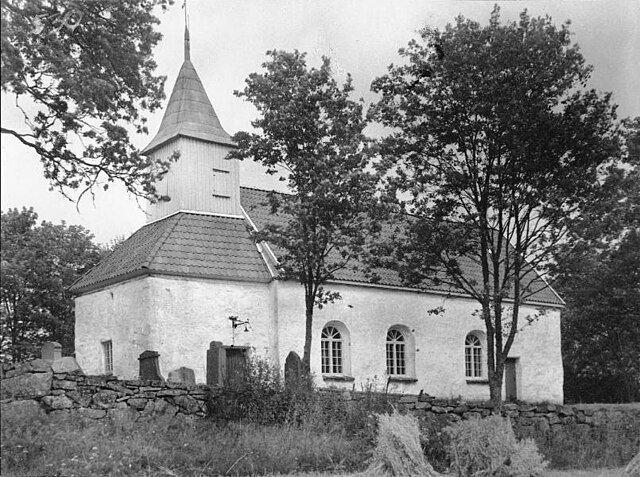
(By the way, I wouldn’t bother wasting any of that pity on the Church of Sweden as an institution. Despite screaming poverty, its assets amount to over $11 billion in land, trusts and membership fees.)
Given all that, you might think it pretty ambitious for our village to have two separate churches – one belonging to the Church of Sweden, the other to something called Equmenia. When we arrived in the village, this was still called the Mission Church – one of the many Non-Conformist variants in the country. About 15 years ago three of these decided to join forces and rechristen themselves, so to speak – hence the ecumenical name. With us, they go even further and often share facilities and services with the Swedish Church.
With so much sharing going on, you might well ask what separates the two churches. Well, the ritual stuff, I guess. But since they share services locally, that can hardly be a deal-breaker. The structural differences are, I guess more fundamental. The Church of Sweden has travelled a long way from the patriarchal moral arbiter it used to be. There are now priestesses, bishopesses, and recently an archbishopess, and the Church now prides itself on its liberal and tolerant stances. There are even regular elections of church officials and board members – by church members only, of course.
But thereby hangs a tale. Despite church and state now being separate, candidates in church elections often stand on very specific party-political platforms. As such the elections are not just barometers for a party’s political standing, but also a means for a party to increase its leverage. Thus it comes to pass: the far-right Sweden Democrats have increased their influence significantly in national and local politics in recent years. So now they campaign to do the same in the Swedish Church. If they succeed, you may be guaranteed that the Church’s stance will become radically less ‘liberal and tolerant’. Happily, despite massive campaigning in the last ecclesiastical election, the SD registered a loss of votes compared with the previous election.
With Equmenia and most other ‘Free Churches’ there are no such elections, since their structure has traditionally been bottom-up, and more locally based. But that doesn’t make Equmenia and the rest of them apolitical exactly. KD, or the Christian Democrat Party has strong roots in the Free Church, most notably the Pentecostal Movement, and claims a Christian basis for its programme. But given the party is at present a member of a ruling coalition that governs only with the explicit permission of the far-right SD, you might question how many of those values have been jettisoned. As you might guess, the SD cup is hardly overbrimming with loving kindness.
But notwithstanding KD and SD, and much as I dislike the idea of God, I find much to admire in all this. Given the absence of anything remotely similar to a pub within walking distance, the two congregations generate and preserve a sense of community that would be otherwise lacking. And as with much else in Sweden, (for example the local clubs, societies, unions, whatever you like to call them) they function as self-help groups. Which is a huge plus when you think how much the principles of the ‘People’s Home’ and the Welfare State have largely disappeared from the agenda of nearly all political parties – including the one that came up with them in the first place. If you’re a church member, you’ll tend to rely on, and employ, other members. So when we had a new bathroom installed by a (very) local contractor, he in turn employed a tiler, electrician and plumber from his own congregation.
We didn’t mind. Why should we? He is as honest as the day is long (summer only) and is a very nice man. And we know where he lives.
It’s almost enough to make you regret you’re a non-believer. Only a few days after we moved house, we were visited by two elders from the respective churches welcoming us.
And I expect many of my complaints about Swedish lack of civility would disappear if we (or I at least) were remotely clubbable, whether in a secular or non-secular fashion.
But I’m not, so there we have it. I at least draw one (other) benefit from churches in Sweden. They’re not only (often) attractive cultural and historical landmarks, they are even more often the only landmarks. I’m not sure whether that’s because the Swedes built so much in perishable wood or whether it’s down to the previously all-powerful Social Democrat Party’s desire to abolish the past in the name of the future. But that’s the way it is.
Stockholm’s not a problem, of course. It’s a beautiful city full of historical sites. And the other larger towns usually have enough to recommend them to make a visit of a day or two to be worthwhile. But get out in the sticks (where we live) and there is little to be enjoyed by sightseeing visitors. Except for the churches. When they’re open, that is. And when the Puritan vandals of the Reformation haven’t managed to destroy or whitewash everything of beauty and interest into oblivion.
But most of all, there are the free loos, of course.
So let’s hear it for the Swedish Church. If nothing else, it helps reduce infections and ruptures of the bladder.
Thanks as usual to wikipedia for filling in the gaps in my brain.
And to wikicommons and Jacob Binck for the pictures.
 Letters from Sweden