I can’t say Brazil was ever near the top of my bucket list. Papua New Guinea, since you ask. But the planned trip to PNG was infected by the pandemic. And so was my enthusiasm.
Nonetheless, Brazil is big enough to have enough Nature left, despite the encroachments of Man, Beast and Bolsanaro. It also has Rio – cool if you get turned on by being caught in the crossfire between paramilitary police and slum dwellers; samba – if you get turned on by swivelling your hips to an undetectable beat; and caparinha – if you get turned on by diluted alcohol. Since I fall into none of the above categories, there are always the birds – of which the country has just under 2000 varieties.
Yet still. The country has never struck me as exotic. I mean, everyone’s heard of it. So you can’t come back and have the satisfaction of hearing your friends ask ‘Is that a country?’ when you explain where you’ve been.
Needs must, however. After all, that really is an awful lot of birds – third only to Colombia and Peru. And when the Wife and Relatives ask whether you would you like to go somewhere that has mammals to look at just for a change or would you prefer to spend the next three weeks getting cabin fever, your mind gets made up for you. Kind of.
So my sister booked a tailor-made tour with Naturetrek, probably the largest British company specialising in naturetrekking. As usual, Wife and I flew over to Heathrow and overnighted there before the long-haul. Since we had some time to kill at the hotel before we checked in, we went walkabout. Really, I’d no idea there was a regional park right next to the airport. It’s called Harmondsworth Moor. And to get to it from where we were staying, all you had to do was walk across the road, past the Sheraton and the ‘Immigration Removal Centre’ and turn right.
Let me say that again. Yes, the IRC is right next to the Sheraton. There’s sensitivity for you. So just before being repatriated to your favourite war zone, or one in a country you’ve never heard of, you can see just what you’re going to miss out on. It didn’t ease my conscience much when a woman outside the Centre bummed a cigarette off me. She wanted the dog-end that was still in my mouth.
But the Park was a lovely surprise. I guess the birds get used to the competition from their mechanical counterparts, because they were about in large numbers, and the parakeets served as an appetiser for the main course to come. These birds are also, if you think about it, illegal immigrants. But considerably less easy to repatriate. Well done, birds. Keep it up.
The flight went smoothly enough. But then they usually do. My problem is the gauntlet you need to run to get on the bloody plane. This time the main challenge came in the form of a bossy member of the Latam ground staff who insisted on double-checking all documentation in one of the queues to the bag-drop, while the other queue sprinted freely through non-existent hurdles. It was some consolation that we’d been assured that Latam in Brazil provided priority lines for customers over sixty.
At the other end, by contrast, everything went smoothly and very quickly. So we emerged with our baggage in record time to be met by a young lady waving our name in the air and speaking no English. She led us to the driver that would take us to our hotel. He also spoke no English. This turned out to be a common failing amongst an otherwise perfectly acceptable citizenry.
We’d not wanted to fly on immediately into the interior on arrival in Sao Paulo. (I know there’s a tilde there somewhere but I can’t persuade my keyboard to stick it where it should be stuck). This was why Wife and I had come out a day before the rest to spend a second overnighter, this time in SP in a hotel called for reasons best known to itself ‘Panamby’. Apparently the word means ‘a challenge’ in Malagasy. I leave that thought with you.
The hotel had been selected on the grounds that it was not far from the onward airport and it actually had grounds. This turned out to be a patch of grass and some trees, which at least was more than could be said for the other hotels in the area. It was a little down-at-heel, but had a receptionist who spoke enough English to check us in and offered room service, which saved us from the awful communal buffet. The only real downsides were the joiner that was drilling and hammering just outside our room while we tried for a siesta, and the maids that wanted to clean our room under the misapprehension that we were about to check out rather than just checked in.
Eventually both maids and joiners punched out and we got some sleep. So we were pretty chipper next morning, especially compared to the rest of the family, who we met up with on the other side of security after their transfer. And after our long queue to the priority bag-drop. It turns out everyone in Brazil, apart from Jair Bolsonaro, has priority.
So onwards and upwards – this time with a two-hour flight to Cuiabá, the main city of Mato Grosso, where the Pantanal is located. There we were met by Jamil, who was to be our guide for the next week. He was a pony-tailed Ecuadorian of Syrian and indigenous extraction. There’s a novel in that somewhere. But Jamil wasn’t telling. It was the end of a long tourist season.
We settled into the mini-bus for the drive out to the Pantanal and our first lodge. This was a working farm called Pouso Alegre, which I guess means ‘Happy Lodge’. To get there we had to travel for a few hours along roads that started as asphalted. When we passed through the gates of the National Park and onto the Transpantaneira Highway, it became a dirt track.
Just before entering the reserve, we’d stopped at the last town we would see for a while – Poconé, a Wild West kind of place minus the saloons and gunfights but plus something called a churrascaria, where our guide had booked a meal for us. Sadly, he hadn’t read the small print. This was an eating place that specialised in barbecued meat and the party included three abstainers. When we explained this to Jamil, even the meat eaters were left meatless. Still, it was a nice meal. Brazilian beans are quite tasty.
Then it was full steam ahead to the lodge. I shrieked delightedly when I spotted rheas in a field. They are a member of the ostrich family and very photogenic. Naldo, the driver, stopped to allow us to take pictures. Over the next couple of days we would see dozens of them. I kept my shrieks of delight to myself in the future. For the most part.
The lodge was a hacienda/ fazenda surrounded by trees and cabins – charming, rustic and secluded. Meaning that after we turned off the ‘main’ road, we still had a tortuously slow twenty-minute drive before we rolled up outside the reception. Still, it was worth it. Extraordinarily tame coatis and capuchin monkeys ambled and gambolled round the lodge buildings, as did curassow (not a turkey), caracara (not a Eurovision entry) and ibis (not a hotel).
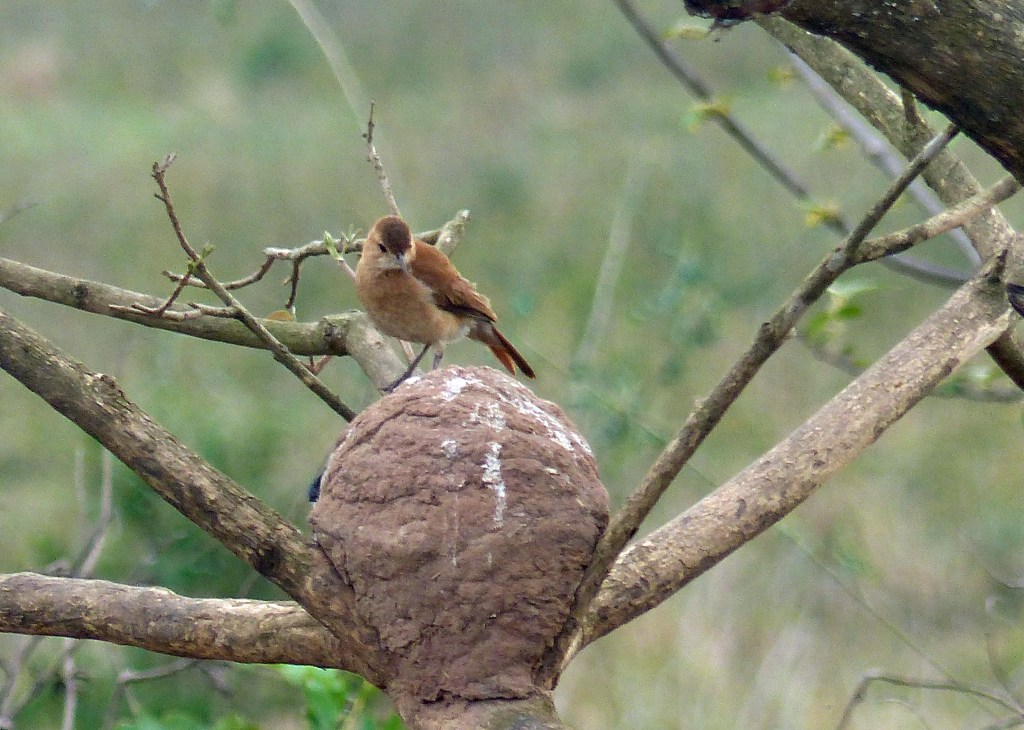
Once we’d settled in (5 minutes), we set out on an open-truck safari of the waterholes of the farm. It was the end of the dry season, so these were popular with both birds and mammals. Agouti (think guinea pigs on steroids) and capybara (think steroid overdose) abounded. Cayman basked on the dirt road in the sunlight. We even had our first view of brocket deer and tapirs at the holes. Hyacinth macaws, the largest of the species, flew overhead, while horneros quarrelled and foraged on the ground.
In case you’re interested, and even if you’re not, the horneros belong to a family called ovenbirds. There are dozens of species and they build nests like clay ovens. The horneros themselves are so good at it, they are privileged with a name that means ‘baker’. They’re a prime example of a bird that looks drab on the pages of a bird guide and beautiful in real life.
Jamil, bless him, had an optimistic opinion of our stamina. Those members of the party that hadn’t broken their journey in Sao tilde-less Paulo began to wilt as we segued seamlessly into a night safari, taking in some cute and confused nocturnal rabbits on the way back to dinner. So much so, that on return Sister headed straight for bed without eating.
She missed very decent food and an ocelot. Halfway through dinner the dozen or so guests were invited to interrupt their meal to watch an ocelot getting his. Cheating, I know. But the cat really was wild. He’d just got to appreciate dietary supplements every now and then. Like when new guests arrived, I suppose. I was thrilled. I’d wanted to see an ocelot even more than a jaguar, and though these had been ‘guaranteed’ farther down the road, nobody had mentioned that we might get a sighting here. ‘Sighting’ is probably an exaggeration. It was dark, so we’re talking about semi-silhouettes and a camera shot that was so multiple that the ocelot resembled a domestic cat seen without eyeglasses. But what the heck.
Sister had recovered fully by the next day and took the ocelot miss more calmly than I’d have managed. The daily round had been established on the first afternoon – waterhole safari by days and roadside safari by night. So we added to the tally of beautiful birds in the sunlight and enjoyed marsh deer, peccaries and crab-eating foxes at dusk. The last of these sounds exciting. But to be honest, if you didn’t see it eating a crab you would take it for a scabby mongrel rather than a fox. Nonetheless, watch this space. They are not strict pescatarians. Neither am I for that matter.
Next day we were due to move on and into the Pantanal proper. But we would have time for a pre-breakfast walk. So I got up early and stood under a palm tree for my first smoke of the day. Just opposite I watched a young capuchin climb down from a tree and walk towards me, hissing. I was obviously queering his pitch, so I moved politely to the side. He eyed me suspiciously, then bolted up the palm tree. There followed a tremendous squawking sound.
‘Odd,’ I thought.
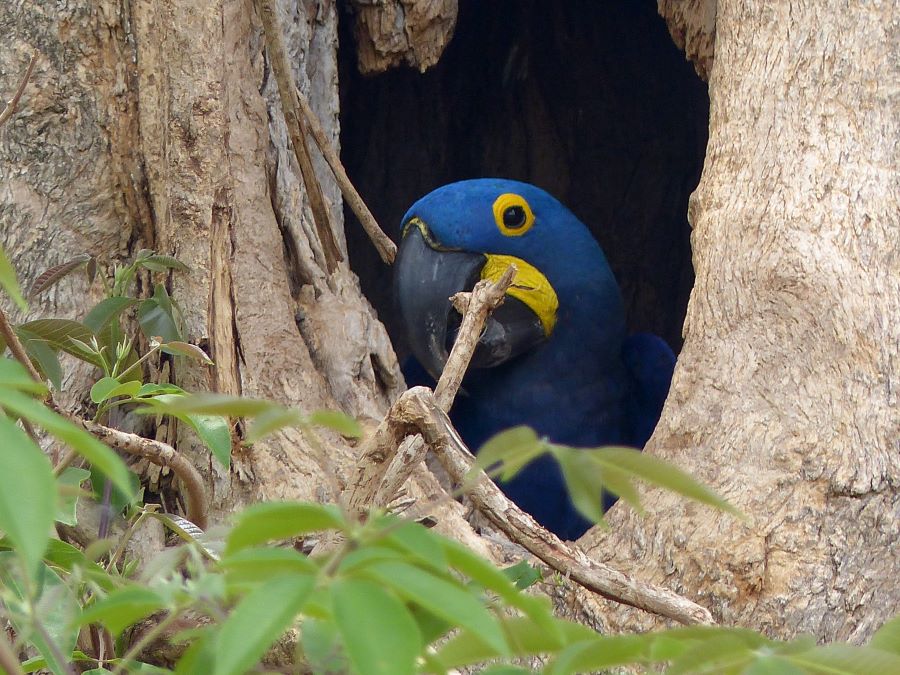
Suddenly two huge birds flew out above my head. Hyacinth macaws! As I mentioned, we’d seen these flying metres above when all you could make out was their shape. I woke Wife and we dashed off to the new tree they’d perched in. Fantastic. A basso profundo cobalt-blue set off by bright yellow eyeliner. It was then my camera decided to shuffle off the mortal coils of autofocus and zoom.
Darn, I said to myself. Or something similar. And not just to myself.
Still, your intrepid explorer does not allow himself to be deterred from achieving his mission in life. And yes, reader, I chose to accept it. So we took another pleasant walk round the lodge, saw some new and exciting birds, had breakfast and headed off on Stage 2, depending how you’re counting.
This was back on the Transpantaneira heading farther south towards Port Jofre and the main object of the trip for most of the party. This was jaguar-spotting. As far as I was concerned, this meant spending endless hours on a boat touring the rivers and creeks in the hope of catching sight of a cat’s whisker.
Port Jofre turned out to be little more than a jumping-off point for rides out to the floating hotels that lined the River Cuiabá. There were a couple hotels for those that preferred to sleep on dry land. In one of them, we were taken to a tree that contained a nesting hyacinth macaw. Finally, some mobile-phone close-ups.
Then we were loaded onto a boat and driven out to our own ‘Flotel’. Versions of these littered the banks of the river. They all looked like tenements blocks that had been built on rafts, and all looked in danger of toppling over. Our own bar and restaurant were pleasant and airy, the bartender understood the word ‘caparinha’ and the food was pretty good, if you like fish. We were eating a lot of fish. The Brazilians seemed to understand the term pescatarian to mean a person that eats fish and nothing else. Still this was a closer approximation to the truth than many other places we’d been. So who cared?
Our cabin, on the other hand, was tiny. It contained a king-size bed that left room for nothing else and a shuttered window that there was not enough space to open. But then again we didn’t intend to spend much time in there. So we surely wouldn’t need more. Ha!
After lunch we headed out in the boat again in search of whatever but mostly overgrown cats. There was plenty of birdlife, but little that was new to me. The Jags were the point of the exercise. And much to my surprise we found one. Or rather our pilot was radioed news of the find, so we joined the flotilla and watched a jaguar eat a cayman. Cool for everyone but the cayman. We duly whooed and snapped along with the rest.
But the jag-call had taken us some distance away from the Flotel. So we enjoyed a long ride back taken at speed in driving rain. I’d had the foresight to pack a waterproof jacket. This simply channelled the rain on to my non-waterproof trousers. Back at the ranch, we wrung out our clothes as well as we could and tried to find places to hang them. Given the lack of space, however, we had to do this in shifts. Our clothes got dry just before we left – three days later.
And so it continued, barring the rain. Next day, incredibly enough we had four more jaguar sightings, along with thirty more boats. It went with the territory I guess, but it wasn’t much fun. I didn’t mentioned my funlessness to the others. I mean it was their party, not mine. But when we got back to the boat. They mentioned it to me. They were not happy either. Delighted with the cats, of course. Not to mention the tapirs and giant otters. But not with crowds (nor the illegal jet-skiers). So please could I put it to Jamil. Quiet creeks in future and we’re happy to see what we see. It would be better coming from me.
I wasn’t sure why it would be better coming from me. I’m hardly a natural born leader. On the other hand, in Brazil (priority in queues etc) there is a fitting respect for age and I clearly looked the most decrepit in the group, despite my bro-in-law being six or seven years my senior. So I took the point. And so did Jamil.
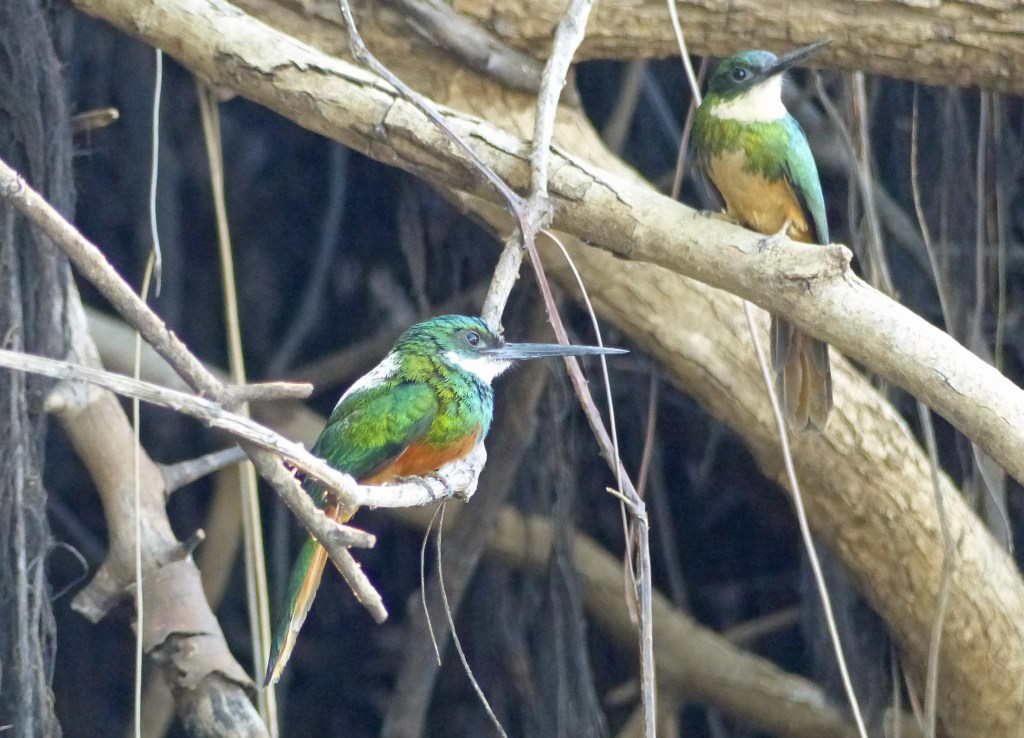
This proved to be a great executive decision by the group leader. Next day we enjoyed tapirs, giant otters and peaceful backwaters in peace. We had our first sight of some jacamars on the side of a creek. These are small birds with long beaks and tails, and iridescent plumage. It is quite impossible not to fall in love with them. Especially when they nest next to the Flotel and perch on the mooring ropes.
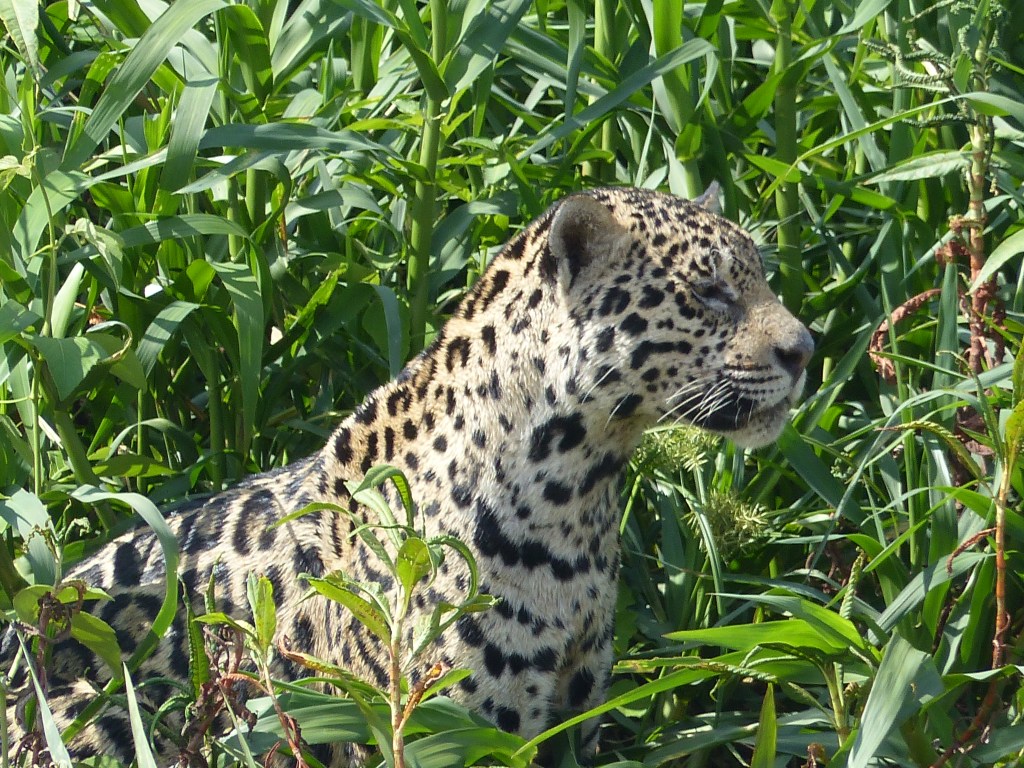
On our way back to the floating boat we enjoyed the highlight of this part of the trip – even for me. A jaguar suddenly appeared through the long grass at the side of the river and walked along the bank as we kept up. Even our guide was surprised. He’d never experienced such an extended view of a jaguar in motion. Even better – we were on our own. Our boatman did his duty, however, and radioed the news through. We left as the others arrived.
So it was all good, man. Contrary to my expectations, we finished our trip to the Pantanal, with I think, 6 sightings of four different jaguars, at least one of which was truly spectacular. But for me, what was weirdest about this was the attitude of the cats themselves. In our boats we were relatively safe, but sometimes we were as close as a couple of metres from them. And these cats can swim. Very well.
Yet they appeared wholly unconcerned. They never looked bored like the lions we’d seen on safari in Africa. The jaguars just went about their business as if we weren’t there. If you had to read something into their expressions it would be hauteur, as if it were infra dig in their eyes to pay much attention to such insignificant creatures as ourselves.
No doubt the cause was the same as in the African parks. Overhabituation to tourists along with little fear of man. But I fear for them. It only takes one cretinous populist president (see above) to remove the protected status of the National Park and the hunters will move in bigtime. It will be like shooting fish in a barrel – but that’s never bothered the big game hunter.
Another day, another journey, another lodge. We headed back up the Transpant and broke our journey back to Cuiabá airport at a lodge called SouthWild. It turned out to be a fazenda again, but one of the more open ranch-like kinds. It lacked the charm of Pouso Alegre, but we were only there for one night. So we had time only for a boat ride upriver, where we saw a skulking agami heron, and underwent a fruitless 2-hour nocturnal vigil for a ‘guaranteed’ ocelot that also hadn’t read the small print of its contract.
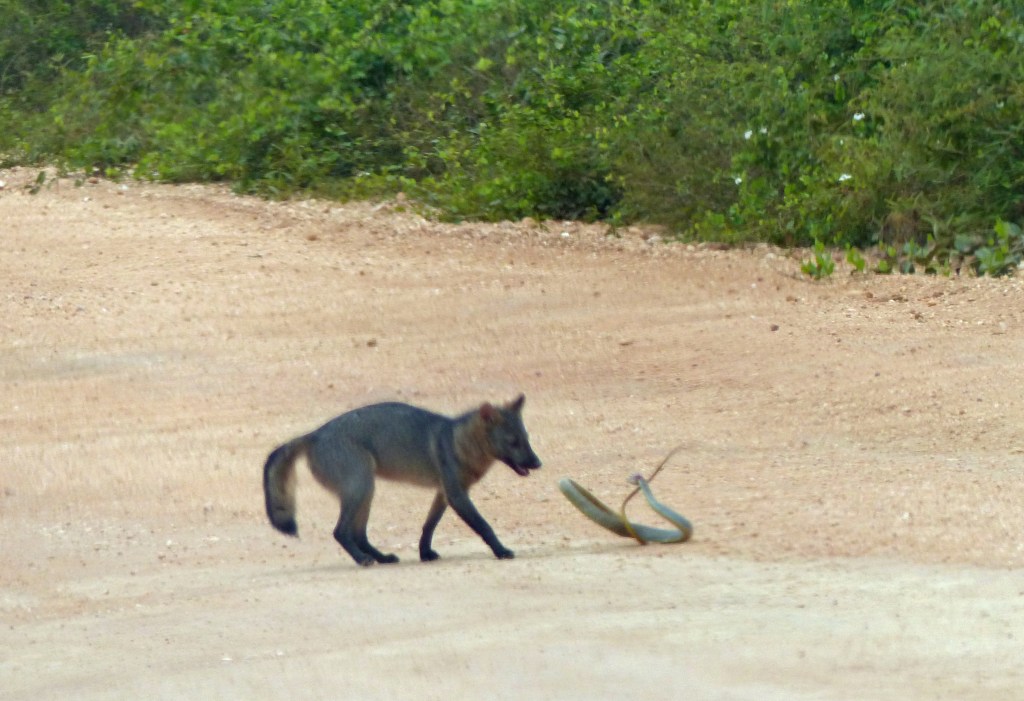
Next day we settled back in the minibus for the long ride to Cuiabá, but suddenly ground to a halt after just a few kilometres. Something was on the road. ‘The Pantanal is full of surprises,’ Jamil said in a bored voice. In front of us were a snake and a crab-eating fox that had obviously not read his instruction manual.
‘A poisoner,’ Jamil explained. And the fox seemed well-aware of the fact. It danced forward, jabbed with its teeth, then hopped back as the snake lunged. This went on for a few minutes until the snake got tired. Then the fox dived in for the kill, snapping the neck of the snake just below the head before carrying it off with a distinct strut to his walk.
Funny, though. We were all rooting for the fox. Mammal solidarity? I mean, snakes have to make a living too. And a killing, I suppose.
At the airport we said goodbye to Jamil with the usual golden handshake and checked in. Again.
Due to a rescheduling by the domestic airline, we’d had to settle for a flight only halfway to our Amazon lodge. This was to a town called Sinop, from where we’d have an estimated 5-hour drive to our next stay. About half an hour before departure, it was announced the flight would be delayed – by at least three hours. If we were lucky, we would arrive in our lodge about midnight.
But we were already lucky, kind of. One of the guides from the lodge, a cheerful chap with a carbuncular face, introduced himself to us. He was called Rafaél and was on his way back to the Amazon after a break with his family in Sao Paulo. We were not alone! I celebrated by going back through security for a smoke outside the airport and bought a beer when I got back in. I’d not seen this brand before. Most of what we’d had so far was 50 shades of Bud. This was different. It was called Louvada and the IPA actually tasted like IPA.
Eventually we boarded and disembarked after an hour’s flight. Rafael gathered us and a couple of Americans, loaded us all onto a minibus and then, thank God, stopped at a baker’s. Yum. Cheese and onion pie, perhaps. The Brazilians seemed to love pies. He got us tapioca pancakes. These were indigestible. And the drive was interminable.
Eventually, we passed through a town that looked like a pocket-sized Las Vegas, with a neon-lit mall or hotel fronted by a huge and elaborate portico. The settlement turned out to be Alta Floresta, where our originally scheduled flight would have ended. Then we swung off the road onto a dirt track. Rafaél tried to keep our spirits up by saying ‘now we’re here’ when we went through a gate. Half an hour later, we pulled up on the bank of a river. Another half hour passed on a launch. Then we docked at a floating deck with lights leading up to Cristalino Lodge.
Our bags were carried off to our rooms and we were carried off to fill in some forms. It was past eleven and we were hungry. But a hard-core of waiters along with our guide had stayed up especially to meet and greet us. The waiters all sounded gay and the lodge looked as though someone had taken an upmarket seaside resort and dropped it into the middle of the jungle. But the fish carbonara was delicious.
As we ate, our guide for the next few days introduced himself as Bruno. He looked like he was fresh out of high school and sounded like he’d graduated in cheer-leading. He explained that, due to our late arrival, we would have a delayed start tomorrow morning.
Good.
When we finally got to our rooms, the sense of floating freely in time and space became even greater. The cabin was large, comfortable and ‘immaculately presented’ with a free logoed water bottle and a box of chocolate Brazil nuts waiting for us on the bed.
All was right with the world. We were in an Amazon jungle Paradise that served Louvada beer.
As agreed, we strolled in to breakfast at the ungodly hour of 6.30, though we’d been woken much earlier by the dawn squabble of a pair of blue and yellow macaws that hung round the lodge. We were served by someone with a shaven head and an earring. He introduced himself as Marcelo and was exceedingly attentive. It all reminded me of upmarket American restaurants where you’re supposed to be on first name terms with the waiter and to have bonded for eternity by dessert.
He took our order for cooked food. This was the only time it happened during our stay. Usually we got up so early that we just helped ourselves to a buffet. By which, we guessed that not all guests were there for the birds. In fact, as we ate breakfast we could see a group doing yoga in a room opposite. Maybe there are Brownie points for performing pilates in the jungle. Whatever.
Breakfast finished with Marcelo taking our order for lunch, a procedure the management had settled on for understandable reasons, but which was a little difficult to cope with early in the morning.
Then it was off with the fresh and cheerful Bruno, first to a 50m observation tower and then on a three-hour walk, which was welcome after a day on the road and in the air. The birds were beautiful but, as expected, more difficult to see in the rainforest. Hence the point of the tower where you could see the macaws, monkeys and cotingas from above.
All except for the antbirds, drab birds that keep to the forest floor and undergrowth. They get their name, not because they eat ants, but because they follow army ants as they ravage through the undergrowth scaring up everything that gets in their path. This in turn becomes food for the antbirds. They are, to be honest, quite cute and often confiding. But, as I say, they’re hell to see properly.
By dinner, we were beginning to conclude that the food was a little odd. We had gone from the rustic to the nouvelle cuisine in one precipitous leap. We happily blamed the yoga guests.
The next day followed a similar pattern, with a hike in the morning before it got too hot. Other than yoga, there is little else to do in the jungle. Bruno, bless him, had designed a programme that at least varied the habitat. This time we took the boat upriver a little, then hiked to an area of deciduous trees and rocky outcrops. This also helped with the bird-spotting since the landscape was more open. But it also meant it was hotter. We added rare white-lipped peccaries, marmosets, along with trogons and paradise jacamars to the list.
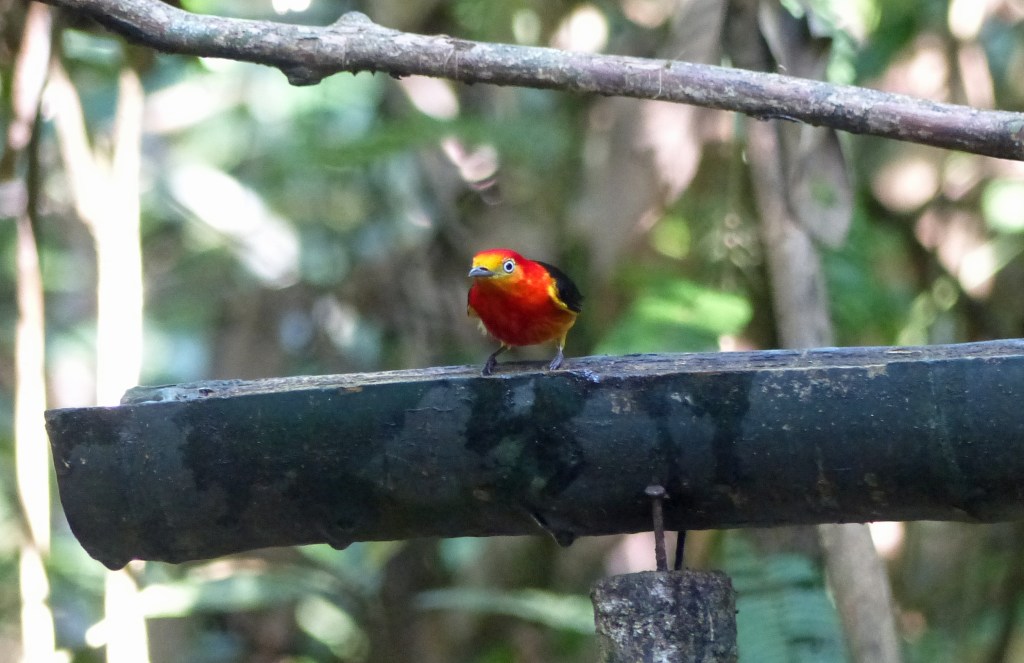
Post-merid was devoted to hiding. Which is to say, we sat in a camouflaged shelter and hoped the birds would come along. Bruno set out bowls and dug-out logs of water for the customers to refresh themselves. We settled in dutifully for the long wait. But almost immediately a band-tailed manakin, one of the birds with a wacky courtship dance, turned up to bathe himself, then shake off looking both dazed and craze-eyed by the experience. He was followed by a snow-capped manakin and a barrowload of antbirds, including the outlandish bare-eyed – all of which would have been nigh impossible to find without the help of the soda fountains.
And so it went. Our last day was given over to a Brazilnut-tree walk and a late afternoon boat trip, where Bruno shared some fruit and his short life-story with us. Then he even asked us about ourselves. Bless.
This brought the curtain down on our tour for most of the group. Only Niece and I joined our guide on a night walk – tarantulas, snakes and the amazing wolf spider. And only we two survived to tackle the second observation tower on the final morning. Again macaws, monkeys. Even some tanagers – a foretaste of what Wife and I would enjoy on our final stage of the trip.
After breakfast we were asked to fill in a questionnaire, which shows how high-minded the hotel staff were. Only my sister deviated from the consensus that this was an excellent lodge. For her, it wasn’t rustic or remote enough. For my part, I felt the journey to get there had been quite arduous enough. God knows how long we’d have had to spend to get to somewhere more isolated. Then there was the question, barring helicopters, of how exactly we could have got there. Having said that, it wasn’t remotely rustic either. And so lacked the charm of other lodges we’d stayed at. Sis went further and claimed that Cristalino was so upmarket, they could at least have provided aircon. Which rather detracted from the force of her argument. The lodge ran off solar panels.
Still, rustic aircon had a nice ring to it.
After the questions, it was time for tearful goodbyes and joyful receiving of tips.
We were dropped off at Alta Floresta airfield after the driver had spent 10 minutes trying to open the door. Then it was a direct flight back to Sao Paulo, where we were to overnight before going our separate ways: – Sis, Niece and Bro-in-law to Rio, Wife and I to the Atlantic rain forest.
In Sao Paulo, we’d been booked to stay in the Ramada. We’d been told they ran a shuttle on request and were given the number. On arrival, we duly phoned through and got an answer in Portuguese that turned out to mean ‘unavailable’. On further enquiry, we found out that the hotel had changed its number and done away with the shuttle service. So we headed for the taxi rank and all six of us plus luggage were loaded into a medium-sized saloon
To remind you, Ramada is an international chain and this Ramada was serving an international airport. At the reception, they didn’t speak English, though they recognised the word ‘breakfast’. At dinner, the maitre d’ did speak English and told us to sit anywhere since dinner was a buffet. But not just any old buffet. Despite appearing to be on spirit-burners, all of the food was stone-cold. And pretty indigestible. We’d also stayed in bigger rooms in most of the lodges. If you go to Sao Paolo, don’t stay at the Ramada. Or better still don’t stay in Sao Paolo.
Next morning, Wife and I were picked up bright and early by our last guide, Yago, who arrived on the dot, which was quite a feat given the Sao Paulo traffic. Then we headed out of the city. We would, he explained, be lunching at Trilha dos Tucanos (Toucan Trail to you).
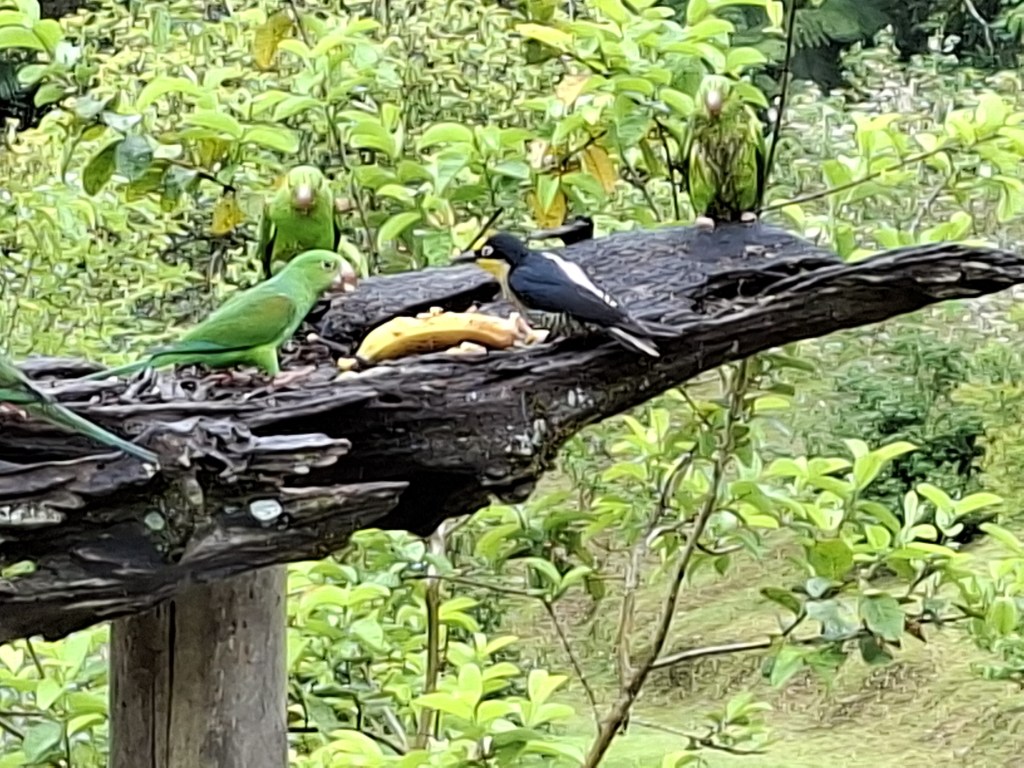
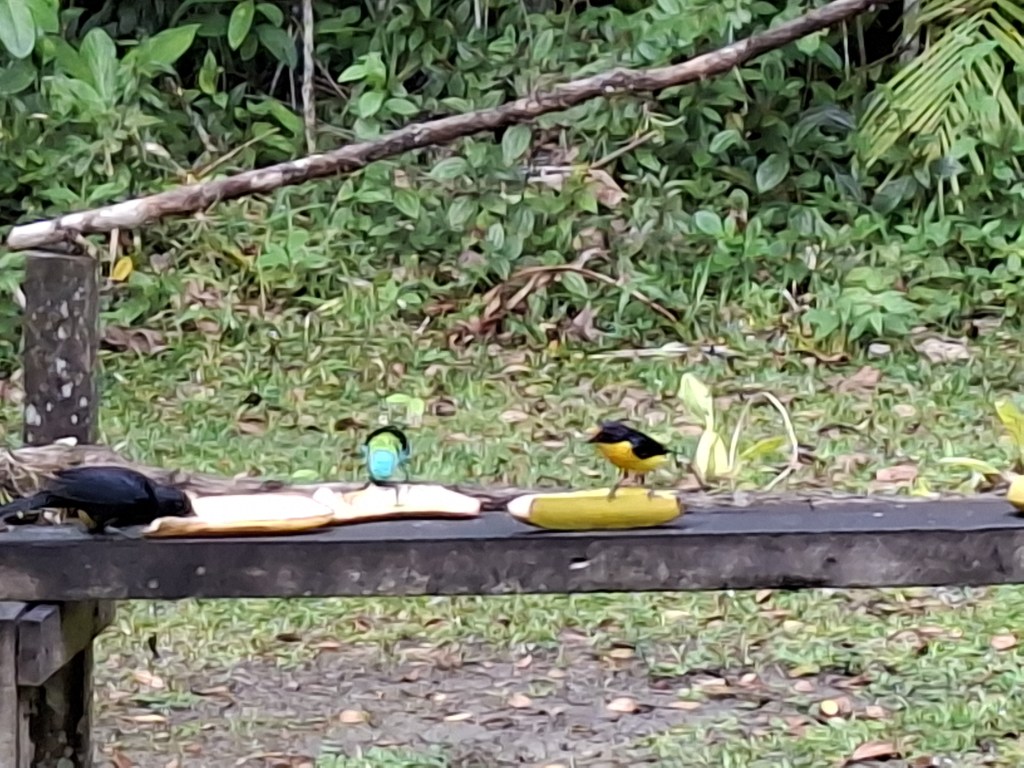
But first, some birds. The toucans took a while to appear. But there were plenty of hummingbirds, parakeets and gaudy tanagers at the feeders, so who cared? My sister would have loved this. The place was rustic too. The lodge was last along a dirt road. What’s more, the cabins looked very basic and for some reason were shaped like large tents. We broke off the birding for a buffet lunch, which was warm, simple but delicious – probably the best we had on the trip. As we ate, we marvelled at the number of Japanese tourists speaking what sounded like fluent Portuguese.
Yago pointed out that Brazil had the highest number of naturalised Japanese living anywhere outside Japan – about 2 million of them. The first generation had come as agricultural labourers, mainly in coffee plantations. About half of these were from Okinawa, as was Yago’s wife. These had the added incentive of escaping from Japanese rule, which was particularly oppressive for Pacific Okinawans.
Fascinating, I thought. I warmed to Yago. He was a biology student with closely-cropped blonde-dyed hair. He was specialising in soundscapes. This, he explained, was the range of sounds that characterised a particular habitat. It also made him an unusual guide, since he was able to identify bird calls without seeing the birds that made them. In fact, he was better at identifying the sounds than naming the birds in English.
As dusk fell, we drove the long way to our own lodge, entertained by the collection of Brazilian songs Yago had downloaded from Spotify. They were a pleasant surprise. I’d thought samba, the whole samba and nothing but the samba. But the songs ranged from tearful self-pitying ballads to joyful let-it-all rip pomp-rock tunes – admittedly with a touch of samba. My favourite was Ney Matogrosso, who had pioneered androgynous glamrock before it caught on in Britain and the US. He also came out of the closet during the military dictatorship in a pretty macho country. Now he is almost 85. I must remember to send him a birthday card.
Not far from our destination, we drove along a stretch of motorway signalled as particularly accident-prone. Sure enough, on the opposite carriageway we noticed a still-burning tanker and then checked out the 20km tailback of stopped traffic behind it.
Eventually, we rolled up outside Espinheiro Negro, which would be our lodge for the next three nights, and hoped it was as attractive as Trilha. As my sister would certainly have pointed out, it certainly wasn’t as remote, being only a few kilometres from the motorway. And the food wasn’t as good as our lunch. Nor were the birds. Nonetheless it was more than adequate, and the cabins were less basic than those at Trilha. They didn’t have aircon, but this wasn’t an issue since it was so bloody cold. More to the point, they didn’t have heating either. An Antarctic front had blown in apparently, and blighted our remaining time in the country.
The couple that owned the place were an interesting pair. Jo, who ran the lodge, was mixed-race and had a dark face, white teeth and a brilliant smile. We never figured out what the husband was called. He was politely formal and pottered round the place. Towards the end of our stay, he told us he’d arrived in Switzerland as a political refugee from Czechoslovakia at the age of seven. He didn’t seem awfully happy with where he had ended up. He did, however, have an excellent selection of cachaça (ha! found the cedilla) which kept me in nightcaps after my duty-free had finished.
The following couple of days were spent birding in and around the lodge. The highlights were probably the Brazil tanager, possibly the largest tanager I’d ever seen, and the cream-crested woodpecker all ready to audition for the next Disney feature. The only outing we had was to a property the owners had recently bought. They’d started to do up the ‘residences’ that were on the land, though these were still pretty basic. But it was the land itself that was the attraction. Rain forest spread from the garden down and up onto the other side of the valley. Honestly, I could think of a lot worse places to end my days.
It was about this time we heard about the raid on the favelas in Rio. About two and a half thousand police had attacked the quarter in a supposed attempt to root out an armed drug gang. The result was a massacre in which more than 130 people were killed. Yago pointed out that the police discovered 300 rifles there. This, he claimed, was 300 less than were found in a raid on a politician who supported Jair Bolsonaro. And while he was on the subject of his pet hate figure, he also mentioned that the governor of the state, who was in charge of the police there, was a member of Bolsonaro’s party.
More to the point, a Brazilian expat lady on our plane from Heathrow had recommended the favelas as an interesting tourist attraction and I’d passed the information along to Sister. I texted her immediately. Fortunately they’d completely ignored my advice. A lifetime of experience and practice, I guess.
Our return flight to London was to leave late in the evening of our last day in Brazil. This left the morning for some final ornithological thrills. Yago took us to Legado dos Aguas or Legacy of the Waters. I’d looked this up online. The website talked about all the exciting activities that anyone but birders could enjoy. After the usual long drive up a dirt road, we arrived at the gate of the reserve. Early, I assumed since it was closed. Yago entertained himself by talking to the people in the car in front who turned out to be colleagues of his.
Eventually the gatekeeper came out to the colleagues’ car and ten minutes later to ours. After another ten minutes he lifted the barrier. But we weren’t there yet. At breakfast, I mean. We drove for a further half hour, past dams and reservoirs and through rainforest. It was an odd set-up. Yago explained the reserve was privately owned, I guess by the electricity companies that created the dams and hydro. The surrounding forest was a protected area. As it presumably was when they built the dams.
The journey was slow, but by now we were used to it. In any case, you couldn’t really travel at more than 10kph without risking damage to the vehicle. Suddenly we saw a sign giving a ‘reduced speed limit’ of 10kph, and warning of the speed bump. Way to go.
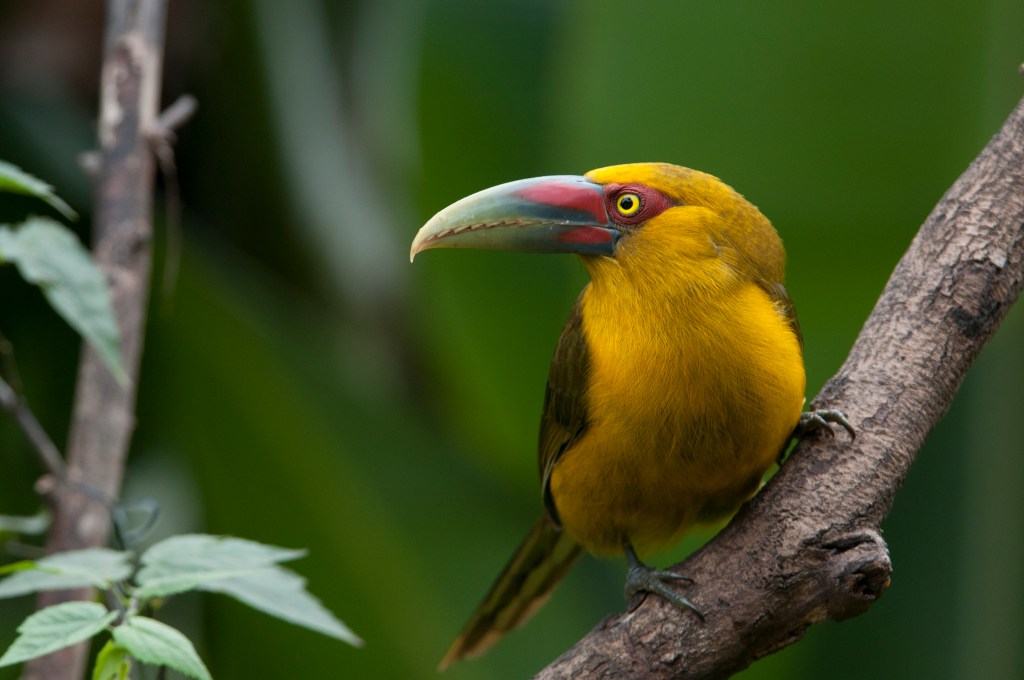
Finally we arrived at the reception area where there were feeders. Besides the usual tanagers and parakeets, Yago said the big draw was the saffron toucanet that came to eat there. Sadly the staff hadn’t fed the birds. Nor us for that matter, since breakfast wasn’t ready. Eventually birds and breakfast came. But no toucanet. Still we saw plenty of other birds as we walked around and then drove up to a helipad (see what I mean?) where there was a bare-throated bellbird sending electrical wind chimes out to passing UFOs. This was very cool. Usually there’s no problem hearing these weird calls, but it’s a devil to see the bird itself. This one was brazen.
Back to reception for lunch, also not ready. So into an area of rain forest, duckboarded for the day-trippers, but nonetheless enchanting. There we ran in to Yago’s colleagues again. They’d brought chairs and settled in for the day to study the behaviour of a very rare nesting antbird – to wit, Salvadori’s antwren. I’d never heard of it. But that’s hardly a criticism. We waited and watched for the bird to come to the nest. True to form, it was drab and to my eyes undistinguishable from most others of its family. But we were there.
Then we weren’t. We’d gone back for lunch – which still wasn’t ready.
After a late lunch, it was time to go. We were only about 120 km from Sao Paulo and according to the Internet, the journey would take about 2 hours. Yago went to pay and we wandered round the carpark, still regretting the missing toucanet. Then it appeared right in front of us – green and yellow with a splash of saffron on its bum, and on its beak and round its eyes – all of which made it look angry with us. I went to photograph it with my phone. It glared at me and flew off.
So it goes. Mostly.
It took four and a half hours to get to the airport, despite Yago’s queue-avoidance tactics. Half that time was spent in transiting through the city itself, which did little to redeem the place in my eyes. We said a hasty goodbye to Yago in the drop-off zone. He’d been great – warm, informative and funny.
Check-in and security went like a (bad) dream and then we found somewhere to grab a meal, rightly expecting Latam’s food to be indigestible. I browsed the Internet to see if the airport had a smoking area. AI advised that the restaurant we were sitting in had a roof terrace just for that purpose. I couldn’t see a roof or a terrace so asked our waiter.
Regrettably they no longer…. The only place I could smoke was in the hotel on the floor below. We entered the hotel and followed the signs. Wife said she’d wait outside so I followed a couple through the doors. Eventually I found the area – a lovely open-air terrace. I inhaled deeply and returned to find that I’d entered illegally. I was summoned to the reception and made to cough up. Equivalent of £4, I calculated. There’d be time for another. But no need to pay next time. I had a coded bracelet strapped to my wrist. Then the receptionist tried to persuade me to hire a room for a couple of hours. Or so I thought.
We exited with me strutting my stuff. Then we ran into Sis and company who told me I’d actually paid $40 for the privilege. I’d got the decimal point wrong – not for the first time. (See the Bhutan blog.) The room hire was presumably included in the cost.
What could I do? I went back and chain-smoked.
The flight went on time. And didn’t crash. These are the only things to be said for the experience. The food was awful, they didn’t sell spirits, and my favourite video game was out of action. Still, we arrived at Heathrow and took separate black cabs to the hotel where we’d overnight again.
Over pre-meal drinks in the lounge, a bloke from Nottingham, who was sitting close by, asked if we were with Naturetrek. I looked over myself and the others for incriminating signs. Nothing. ‘You just looked like a birder,’ he said, which explained nothing really. There must be a hundred companies offering birding holidays. So he must have been psychic.
Still, maybe now I at least looked the part. All I need now is to learn how to act it.
Thanks to Sister and her camera for the good photos. Except for the toucanet. For which, thanks to Renato Martins at wikipedia. The bad photos were all my phone.
 Letters from Sweden