Motoring in Sweden and other places
I was late learning to drive. My father refused to teach me and my mother soon found out why when she tried to help out. So when the dust had settled, I had to resort to private instructors, the first of whom miserably failed with so simple a task as getting me through the driving test.
So I didn’t get my first car until just before I finished my Italian Period. A friend was selling an old Fiat 500 estate. (Yes, they really existed, though I’ve never seen one in any other country.) Problem was, through no fault of my own (or not much), I had no official residence permit. That didn’t stop the authorities from allowing me to work so they could tax me. But it did stop me buying a car in my name.
So I used someone else’s.
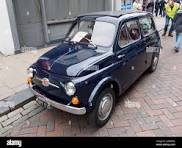
The sharp-eyed amongst you will have noted that I still didn’t have a driving licence. But I had a provisional licence that I hoped would fool any curious policemen. And a co-driver who was young and female and would constitute a back-up plan vis à vis aforementioned police. This was Italy, after all.
So we set off round the peninsula, hopping over to Sicily where I was stopped by a curious carabinieri who duly succumbed to a flash of thigh.
Blissful days, coasting downhill with a following wind at a full throttle 70 kph with the sun roof (read ‘flap’) open belting out Talking Heads on a portable cassette-recorder. In Rome, we even managed a trip up onto one of the seven hills with four friends in the back, three in the front and two with their legs dangling through the sun-flap.
The car drew the line at Etna. I suspect it was not alone in this. Though usually we managed to cope with the need to double-declutch when changing gear, this was too much of a challenge on a 25 degree gradient.
All in all, this was my favourite car ever and it deserved a better fate than to be abandoned on a street in Asti when I decided not to return to Italy the next year.
I ended up instead in Sheffield where the instructor was more successful and the examiner passed me even though I’d buggered my neck the day before the test and couldn’t turn in my seat to reverse. (Anyway, try that these days with the obligatory head-rests.)
Only problem was that I was now a student and couldn’t afford a car. A proper one, that is. I ended up investing in a cheap and probably stolen Vauxhall Victor whose big end gave up the ghost about a week later.
Never mind. My next job was in Egypt, where I wouldn’t have dared drive anyway. The taxi drivers were all potheads and had a habit of falling asleep and allowing their cars to drift into oncoming traffic. The main (so-called ‘agricultural’) road between Alexandria and Cairo was littered with automotive corpses and resembled a scene out of Mad Max.
Next stop was Soviet Moscow where I would need diplomatic plates in order to drive. I was not a diplomat but gave it a go, borrowing a Lada Niva from a friend of the Embassy in the middle of winter. It was a tank to drive, as some pedestrians found when I mounted a pavement trying to do a U-ey. We managed to get 30km out of Moscow and more than half way to Chekhov’s country house before we got lost. Not entirely our fault. Road maps in the country were often intentionally misleading, just in case inquisitive foreigners (read ‘spies’) decided to check out the nearest nuclear facilities. Or Chekhov’s family estate.
In any case, the police had caught up with us by then. The dip plates were a give-away. Foreigners were not allowed out of Moscow without a visa and there were checkpoints at all exits from the city. The militia were relatively polite about our ‘honest’ mistake. We might after all be high-level diplomats with low-level IQ. They escorted us back to the capital.
At least four years in the USS of R provided me with enough cash to buy a car when I went back to Britain to upgrade my qualifications. (This was like chasing your own tail. Every time I improved them, the next level up was required to get a decent job.) This time it was a Lada. My brother-in-law pointed me to a reliable dealer, chiefly since this allowed him to reel off his repertoire of Lada jokes each time I drove up to see them. Then again, I hadn’t earned a fortune in the Soviet Union so this was the only option. Happily the car turned out to be ultra-reliable until it was nicked. So the next on the disassembly line was an aged Capri that I nicknamed Gracie – for reasons that should be obvious to anyone of my age. Like Gracie Fields, the car was brassily elegant and destined to spend its last days abroad.
The abroad this time was Sweden. The car served me well for the most part. True, it didn’t like the cold and soon after my arrival it broke down on the way back from a skiing trip. (Don’t ask.) The fact that it chose to snap its drive chain in the middle of a traffic-lighted crossing in the middle of the night and in the middle of a blizzard wasn’t designed to endear me to it. We were towed back to Gothenburg by friends who were driving a much more sensible and upmarket Volvo. With snow tyres, of course, the idea of which was as foreign as the Swedes.
Still, I kept the faith. I loved her despite her faults. Even if she nearly got me killed on the autobahn when a Danish lorry pulled out in front of me while I was testing the limits of the speedometer. Gracie went into a flap and skidded round to face the oncoming traffic. Of which there was fortunately little. Brake fluid had been leaking onto something it shouldn’t have leaked onto.
This signalled the beginning of the end for the poor car. Next time she was back in Britain she received a death certificate when she went in to renew her MOT. I was there at the funeral.
I’m delighted to say, however, that my bro-in-law is as reliable as a second-hand Lada and offered to sell me the Ford Escort Diesel that he was on the point of trading in. This was a Proper Car and it was the first I’d owned that didn’t look as if it had come from a Rescue Home.
It was still British-registered and green-card insured but this didn’t prove to be an immediate problem. The British plates allowed me to park anywhere with impunity. Fuel was a bit more of a problem. Diesel cars were not so common in Sweden in the early 90s, so when I wanted to fill the tank, I had to drive out into the sticks.
But this was a small price to pay for a car that ran well and no-one wanted to steal.
It was not to last, however. In 1995 Sweden joined the EU. As a result it became possible for me to reregister the car in the place it was being used. Actually I had no choice in the matter, since the British insurance company, on similar grounds, would no longer issue green-card insurance for Sweden. Still, we would manage I thought. Swedish bureaucracy was only marginally worse than the British kind, so I would reregister George. (I disclaim all responsibility for this name. It came with the car.)
Or so I thought. Despite both the UK and Sweden being members of a Common Community they didn’t share common rules about exhaust fumes. It turned out I would have to have a catalytic converter installed if I was going to switch the car’s nationality. This would cost as much as I paid for the car. So back it had to go. I wasn’t allowed to sell it in Sweden either.
Good old pseudo-bro lined up a buyer for me and a good sale price. I took the ferry back and, before completing the sale, drove down the M6 to the Midlands to visit relatives. En route, not far from Spaghetti Junction we were driven into by, yes, you’ve guessed, a Danish lorry driver. I mean, what are the chances?
He denied all responsibility, even if he’d pulled out as we were overtaking him. So I was introduced to the concept of ‘knock-for-knock’ – meaning that I had to pay for the damage he’d caused to my car. And got a much reduced price for the injured vehicle.
So once home again, it was now the turn of the Swedish car market to supply my needs. I settled on a Skoda Fabia – cheap and so I’d been advised (by the same brother-in-law) reliable. It didn’t turn out quite like that, although he was happy. I hadn’t realised but after the demise of the USSR, Lada jokes had now become Skoda jokes. The whole of his best man’s speech at my wedding consisted of this jocular scraping of the barrel.
Frankly I was disillusioned. The car had the acceleration of a Fiat 500 and was totally lacking in charisma. Perhaps there was something in the jokes after all. So one night I got drunk and drove it into a neighbouring garden.
For some reason, the judge didn’t appreciate my aesthetic principles and banned me from driving for a year. Oh, and she sentenced me to prison for a month. I made a case for this to be commuted to house arrest with time out for good behaviour and work. So I was permitted to serve my term with an electronic anklet and regular alcohol tests. The pre-condition of this milder version of being banged up was that we should have a functioning telephone line, these being the days before fibre cable and wifi.
I was all set to go. There were four hours left before the officials were to arrive, check the phone line and install the anklet. Suddenly the phone went dead. Some idiot at one of the summer cottages up the road had chopped down a tree that had fallen across the cables and brought them down. For once the privatised national phone company did us proud. They fixed the line and the connections to our house marginally before The Arrival. So I was able to work while my term was being served, rather than descending into a life of depraved criminality by being subjected to bad company.
At least I survived the ordeal, which was more than the car did. So that was the end of Skodas, amongst other things.
From then on we’ve had ultra-dependable, ultra-small and ultra-unassuming Hyundais. I’ve driven into a few ditches under the influence of ice, but then so has my wife. I’m a reformed character, guv. Honest.
I’ve also in the last few years done a fair amount of driving abroad. I say ‘I’ because the wife totally refuses.
This has involved hired cars on the Continent, in the UK, in Australia, the US and Costa Rica.
Of all the places I’ve driven that I like the least/ hate the most, Paris is unrivalled. The traffic system is chaotic, the driving anarchic and the drivers psychopathic. Oh, and while I think about it, I’ll happily avoid anywhere south of Lancaster in the UK in future.
And of all of these places, I’ve enjoyed driving in Costa Rica most. Once out of the capital and onto the Pacific ‘highway’, you just roll your windows down and let the breeze take what’s left of your hair. The only thing to detract from the enjoyment is the need to slow down to a crawl when passing within a kilometre of schools. And in Costa Rica there are lots of school. Well done Ticos! You’ve abolished your army and invested the money saved in education. Still, it’s hard to keep your attention focused when the scenery is so beautiful. The only place I’ve ever been done for speeding is outside a school in Ticoland.
Sweden comes a strong second-best. The scenery isn’t quite so magnificent and only a fool would drive with the windows open in winter. But once out of the big cities, there is amazingly little traffic. Even on the main road between the two largest cities, which makes dubious claim to being a motorway in places. And the farther north you get, the sparser the traffic becomes. Once into Norrland, you’re more likely to find reindeer on the road than cars.
Not that motoring here is totally hassle-free. Farther south, other wildlife are a major hazard – most notably elk. I don’t know if you’ve ever seen one, or even have an accurate idea of how huge these creatures are. They are engagingly ugly, weigh about 600 kg, are over 2 metres to the shoulder and have absolutely no road sense. So you seriously don’t want one coming through your windscreen, airbags or not. They are involved in over 5000 accidents a year and regularly cause five or more fatalities. (People of course, dummy. The Traffic Authority doesn’t count the elk deaths. Poor elk.)
What’s more, even if Swedes in the round could benefit from better road manners, they rarely give way to road rage and are on the whole pretty good drivers. Like many things in Sweden, driving is heavily safety-conscious. And for the most part, people drive in a straight line and stick to the right side of the road. Which is of course, the right side of the road.
But that wasn’t always the case. Until 5.00 am on September 3rd, 1967, aka H Day, it had been obligatory to drive on the left. (Where the road allowed, of course. Like many others, we live on a very much single-track lane.)
The reason for the change was, partly, to adapt towards the rest of Europe, though Sweden wasn’t then a tourist hotspot, nor had globalisation and bridge-building caused the road to be inundated with lorry drivers from the Continent.
Sweden being Sweden, a more convincing argument was that in favour of road safety. All Swedish cars had their steering wheels on the left-hand side already and, as far as I can work out, always had done. As you will have experienced if you have driven on the Continent yourself (assuming you are British), then you’ll have noticed this can be inconvenient and even dangerous when overtaking. (See Danish lorry driver above.)
So it made sense to switch sides. But it does beg the question of why the Swedish steering wheel was on the wrong side to start off with. Well, apparently the government had promised at a very early stage (like the birth of mankind) to institute driving on the right but never got round to it. So mass-producing vehicle manufacturers had put the column on the side of the car that would in time become the right one (ie the left), if you follow. Volvo, for example, had been producing autos of this kind since 1927.
This all seems pretty bloody-minded on the part of the first party or second party or both. I guess you could argue that most of the cars manufactured for export were to countries that drove on the right. But then, they also made vehicles for the British, Japanese and Australia designed for driving on the left. But didn’t sell them in Sweden.
Oh!
On the other hand, before you cast your preconceptions of Swedish efficiency to the seven winds, the actual switchover to the right carriageway went extremely smoothly, given that the country had about 8 million inhabitants that had to change the habit of a lifetime. Well, to be fair, this eight mil., with the exception of a few urban pockets of intensity, were spread out over a country that’s the fifth largest in Europe and about twice the size of Britain.
But that‘s a minor bonus. It also helps that Swedes are, or used to be at least, a fairly conformist lot, and generally have had governments that are sensible enough to be worth listening to, except when they are promising to change the side of the road you should drive on. So apart from a few minor lapses of concentration this went fairly smoothly.
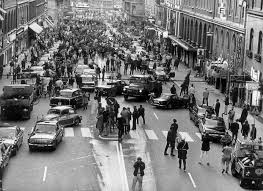
It also helped, of course, that there were no motorways to complicate matters further. Not to speak of, that is. The actual first stretch was created in 1953, but since it ran between Malmö and Lund, a distance of not much more than 10 miles, it didn’t really present any serious problems. Other so-called motorways were really only bypasses that went through towns rather than round them. The Swedes are very direct people.
That said, a whole load of junctions needed to be changed, along with all the signposting, which inconveniently now was on the wrong side of the road. To do all this overnight was a challenge even to Nordic efficiency. Of course, what really happened was that the new signs were put in place and simply screened off until H-day, when the screens were dramatically whipped off. But still, this was an impressive achievement and I’m sure most of the one and a half mil drivers patted themselves on the back afterwards for managing to cope with the new system.
That said, I wonder how they really felt about the change. There’d been a referendum in 1955 when the public had been asked whether they wanted to drive on the right or not. The result was that 83% of those that voted said no. Hence the wait while the government instead commissioned a report that recommended the switch and then decided to re-educate the public. The re-education didn’t make the mistake of asking the general opinion again. But it does explain why people were so well-prepared for right-hand traffic.
Public radio also got in on the act, broadcasting ‘Håll dig till höger, Svensson’ day round. Translated, this means, ‘Keep to the right side, Svensson’ and originally had nothing to do with traffic. It referred instead to being faithful to your girl, ‘to leftify’ in Swedish meaning ‘to cheat on someone’. But it served the purpose and shows that even Scandinavians have a sense of humour.
And that was more or less it when it came to major innovations in driving in Sweden. Drivers could now relax on their studded snow tyres and behind their inertia-reel safety belts (Swedish invention), airbags and steering wheel in the knowledge that they wouldn’t have to think too much about driving until the invention of the self-driving car when they wouldn’t have to think at all.
True, the roundabout posed a bit of a puzzle in the short term. When I came to live here, there were, as far as I could see, none. It turns out that the first one was built in the fifties in Linköping, and my old workplace, Skövde, was also quite fond of them from a relatively early stage. But they never really caught on anywhere else in the country until the 90s, when for some reason there was something of a boom in building them. It became so fashionable that I’ve come across them in places where there is absolutely no need for a ‘rondell’ as they are known here. You’ll have gathered by now that Swedish governments, both national and local, rarely do things by half-measures.
I recall when they were first introduced into our local town, the result was mass paralysis brought on by panic. I say ‘mass’ but that is, of course, something of an exaggeration in a town of barely 4000 inhabitants. Caution was, for most, the name of the game. When someone did move, it was to try to assert the principle that one gives way to traffic coming from the right. This is a jolly good rule and functions pretty well everywhere except on roundabouts, where right-hand traffic travels anti-clockwise round the island and traffic entering comes from the right. Hence the paralysis. It took a couple of years before the message soaked in that traffic on the roundabout has precedence over traffic entering. The debate of how to use your indicators when entering and leaving, however, still appears to be ongoing.
In the course of time, rondeller, or circulation places as they are officially called, became so popular that a fashion developed for decorating them. This first occurred (legally) in Linköping, which once again found itself in the roundabout vanguard. Or avant garde, I suppose. This first took the form of a commissioned ‘sculpture’ of a concrete ring, of the same circumference of the roundabout, but placed on its side and enigmatically named Cirkulationsplats II. When this was vandalised, a smaller figure of a concrete dog took its place. Nothing daunted, these serial vandals decapitated it. Never fear. The council once again rose to the challenge and this time put a metal version in its place.
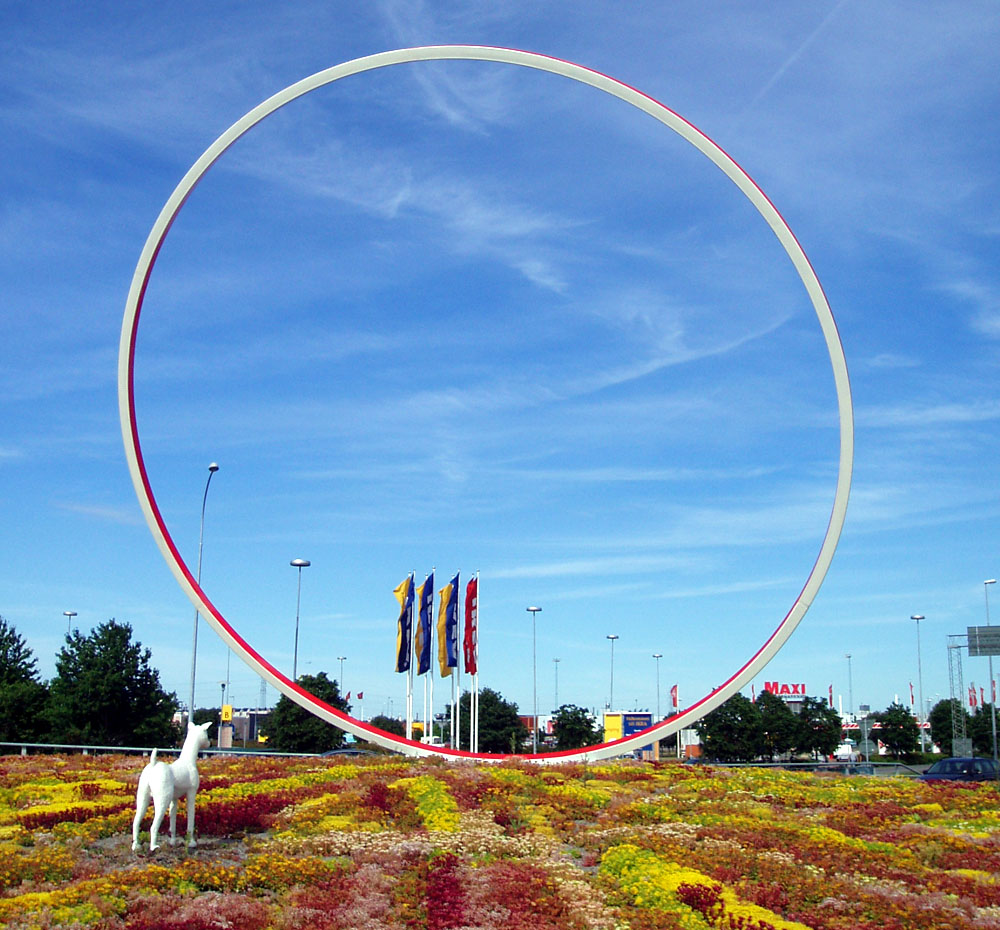
This in turn inspired some artistically-inclined locals to start a trend. On one of the other roundabouts (recall Linköping has many to choose from) they installed their version – this time a wooden dog. As the original artist conceded, dogs are after all social animals. Needless to say, however, this too was vandalised. Repeatedly. Linköping was also clearly showing the way in the desecration of roundabouts.
But the fashion caught on elsewhere. Suddenly dozens of rondellhundar sprang up across the nation. This was a guerrilla art that Banksy would have been proud of. Most local councils eventually reconciled themselves to the fact that the phenomenon was here to stay, was harmless and gave the public pleasure, so stopped pulling down the installations after a while.
So there you have it. If you want driving in the countryside to be an unadulterated pleasure and driving in town a whimsical and/ or aesthetic thrill, then come to Sweden. And good luck with it, since to get here with a car from the UK, you’ll possibly have to drive through France and Belgium and definitely through Holland, Germany and Denmark. They stopped with the ferry to Gothenburg in 2006. So it goes.
Thanks to wiki as usual both for info and pix.

